
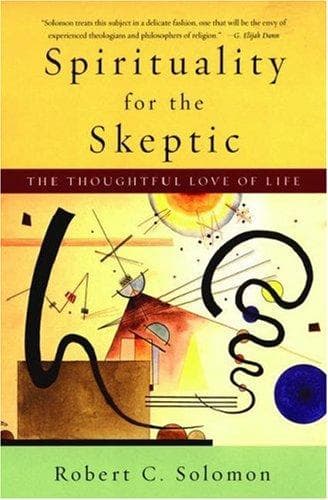
Spirituality for the Skeptic: The Thoughtful Love of Life
الروحانية للمشكك: الحب المتأمل للحياة
Spiritualité pour le sceptique : L'amour réfléchi de la vie
Editorial summary
This monograph presents a distinctive philosophical approach to spirituality that deliberately eschews traditional religious frameworks while maintaining depth and rigor. Solomon constructs what he terms "naturalized spirituality," grounded in passionate engagement with life rather than belief in transcendent deities or supernatural realms. The work represents a significant intervention in contemporary debates about meaning and value, particularly for those who reject theistic worldviews yet seek substantive alternatives to materialism or nihilism.
Solomon's central argument reframes spirituality as "the thoughtful love of life," emphasizing emotional richness, ethical commitment, and philosophical reflection without recourse to divine entities. He develops this position through critical engagement with both religious traditions and secular philosophies, drawing particularly on existentialism, romanticism, and virtue ethics. His method combines conceptual analysis with phenomenological description, examining experiences typically categorized as spiritual—awe, gratitude, cosmic feeling—while providing naturalistic interpretations that require no supernatural commitments.
The work engages critically with several intellectual traditions. Solomon challenges conventional religious spirituality for its otherworldliness and dogmatism, while simultaneously critiquing reductive materialism for impoverishing human experience. He positions his naturalized spirituality against both New Age mysticism, which he views as intellectually irresponsible, and cynical skepticism, which he considers emotionally stunted. His approach particularly confronts the assumption that meaningful spirituality necessarily involves belief in God or acceptance of religious metaphysics.
Solomon's contribution to the God debate lies in demonstrating how traditionally spiritual values and experiences can be preserved and cultivated within a thoroughly naturalistic worldview. He argues that rejecting supernatural beliefs need not entail rejecting spirituality itself, thereby challenging both religious monopolies on spiritual discourse and atheistic tendencies toward deflation of meaning. The work provides sophisticated philosophical resources for those seeking depth and transcendence without theism.
The monograph's significance extends beyond academic philosophy to broader cultural conversations about post-religious meaning-making. Solomon offers intellectually rigorous yet practically oriented guidance for cultivating spiritual sensibilities through aesthetic experience, ethical engagement, and philosophical reflection. His emphasis on passion, gratitude, and cosmic consciousness as natural human capacities rather than divine gifts represents an important contribution to secular approaches to traditionally religious concerns. The work thus serves as both philosophical argument and practical philosophy, addressing the spiritual needs of skeptical modernity.
Argument formulations engaged
Solomon, Robert C. (2002). Spirituality for the Skeptic: The Thoughtful Love of Life. Oxford University Press, USA.
@book{spirituality-for-the-skeptic-the-thought,
  author    = {Solomon, Robert C.},
  title     = {Spirituality for the Skeptic: The Thoughtful Love of Life},
  year      = {2002},
  publisher = {Oxford University Press, USA},
  url       = {https://god-database.com/en/works/spirituality-for-the-skeptic-the-thoughtful-love-of-life-2002}
}