
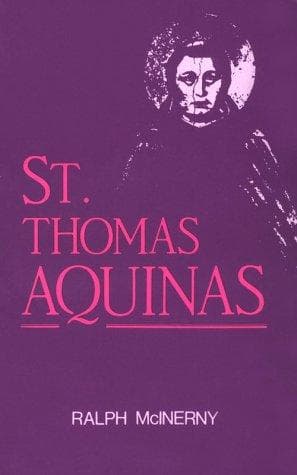
St. Thomas Aquinas
القديس توما الأكويني
Saint Thomas d'Aquin
Editorial summary
Ralph McInerny's "St. Thomas Aquinas" presents a comprehensive intellectual biography of the thirteenth-century Dominican theologian whose synthesis of Aristotelian philosophy and Christian theology fundamentally shaped Western discourse on God's existence and nature. The monograph examines how Aquinas constructed a systematic philosophical framework that continues to influence both theistic argumentation and its critics.
McInerny analyzes Aquinas's distinctive contribution to natural theology through his Five Ways, demonstrating how these arguments for God's existence emerge from empirical observation rather than a priori reasoning. The work explicates Aquinas's methodology of beginning with sense experience and proceeding through logical demonstration to establish God as the necessary foundation of contingent reality. Particular attention is given to how Aquinas transforms Aristotelian concepts of motion, causation, and necessity into tools for theological inquiry while maintaining their philosophical integrity.
The monograph situates Aquinas within the medieval intellectual context, showing how his work responds to both the recovery of Aristotle's texts and the challenge of Islamic philosophy, particularly Averroes's interpretations. McInerny demonstrates how Aquinas navigates between the Augustinian tradition's emphasis on divine illumination and the newly available Aristotelian emphasis on natural reason, creating a synthesis that affirms both faith and reason as legitimate paths to knowledge of God.
Central to McInerny's analysis is Aquinas's doctrine of analogical predication, which addresses how human language can meaningfully speak about divine attributes despite the infinite qualitative distinction between God and creation. The work explores how this doctrine enables Aquinas to maintain both God's transcendence and the possibility of genuine theological knowledge, avoiding both anthropomorphism and agnosticism.
The monograph illuminates Aquinas's lasting significance for the God debate by showing how his arguments established a framework where philosophical reasoning supports rather than undermines religious belief. McInerny demonstrates that Aquinas's influence extends beyond Catholic theology to shape broader philosophical discussions about causation, existence, and the limits of human knowledge. Contemporary debates about cosmological arguments, the relationship between science and religion, and the nature of religious language all engage with categories and distinctions Aquinas articulated. His systematic approach to reconciling revealed theology with philosophical inquiry remains a touchstone for those seeking to defend theism on rational grounds.
Argument formulations engaged
Related works
McInerny, Ralph (1977). St. Thomas Aquinas. University of Notre Dame Press.
@book{st-thomas-aquinas-1977,
  author    = {McInerny, Ralph},
  title     = {St. Thomas Aquinas},
  year      = {1977},
  publisher = {University of Notre Dame Press},
  url       = {https://god-database.com/en/works/st-thomas-aquinas-1977}
}