
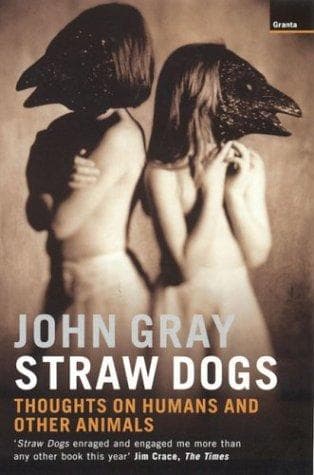
Straw Dogs: Thoughts on Humans and Other Animals
كلاب القش: أفكار حول البشر والحيوانات الأخرى
Chiens de paille : Réflexions sur les humains et autres animaux
Editorial summary
John Gray's "Straw Dogs: Thoughts on Humans and Other Animals" presents a radical critique of humanist philosophy and its underlying assumptions about human nature, progress, and meaning. The work systematically dismantles the secular faith in human exceptionalism that Gray argues has replaced traditional religious belief in Western thought. Through a series of philosophical meditations drawing on sources from ancient Chinese philosophy to contemporary neuroscience, Gray contends that humanism represents merely a Christian heresy stripped of its supernatural elements while retaining its anthropocentric delusions.
The monograph's central thesis challenges the notion that humans possess free will, rationality, or moral agency in any meaningful sense that distinguishes them from other animals. Gray employs evolutionary biology, cognitive science, and philosophical analysis to argue that consciousness itself may be an evolutionary accident rather than humanity's crowning achievement. He particularly targets the Enlightenment tradition and its secular offspring, including liberal progressivism and scientific materialism, which he views as perpetuating religious myths under rationalist guise.
Gray's method combines philosophical polemic with selective scientific evidence to construct his anti-humanist position. He draws extensively on James Lovelock's Gaia hypothesis, Buddhist philosophy, and Schopenhauer's pessimism to argue that humans are merely one species among many, subject to the same deterministic forces and ultimate extinction. The work explicitly rejects both theistic religion and its humanist substitutes, proposing instead a form of contemplative acceptance reminiscent of Taoist thought.
The significance of "Straw Dogs" lies in its comprehensive assault on anthropocentric worldviews, whether religious or secular. Gray argues that the humanist belief in progress and human perfectibility functions as a quasi-religious faith that blinds adherents to biological and historical reality. His critique extends to contemporary atheist thinkers whom he accuses of replacing God with humanity while maintaining essentially religious patterns of thought about meaning, morality, and destiny.
This work contributes to the God debate by rejecting both traditional theism and secular humanism as equally delusional, proposing instead a naturalistic mysticism that finds no special significance in human existence. Gray's position represents a distinctive voice in contemporary philosophy of religion, one that refuses both religious consolation and humanist hope in favor of what he considers clear-eyed acceptance of humanity's animal nature and cosmic insignificance.
Argument formulations engaged
Related works
Gray, John (2002). Straw Dogs: Thoughts on Humans and Other Animals. Granta.
@book{straw-dogs-thoughts-on-humans-and-other-,
  author    = {Gray, John},
  title     = {Straw Dogs: Thoughts on Humans and Other Animals},
  year      = {2002},
  publisher = {Granta},
  url       = {https://god-database.com/en/works/straw-dogs-thoughts-on-humans-and-other-animals-2002}
}