
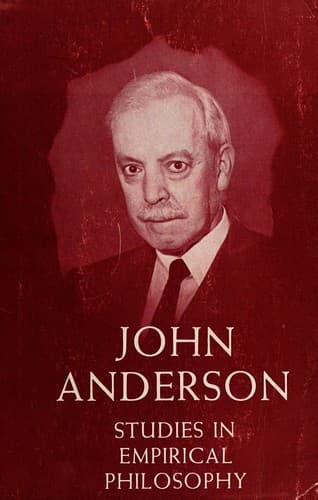
Studies in Empirical Philosophy
دراسات في الفلسفة التجريبية
Études de philosophie empirique
Editorial summary
Anderson's Studies in Empirical Philosophy presents a rigorous philosophical system that, while not directly focused on the God question, develops positions fundamentally incompatible with theistic belief. This collection, spanning essays from 1927 to 1960, articulates Anderson's distinctive brand of Australian realism, which insists on a single spatiotemporal realm of existence and rejects any transcendent or non-empirical entities.
Central to Anderson's philosophy is his doctrine of the unity of being, which holds that everything that exists does so in the same fundamental way—as occurrences in space and time. This ontological position directly challenges theological frameworks that posit God as existing in a special mode distinct from empirical reality. Anderson argues that predicating different levels or kinds of existence leads to logical contradictions, effectively ruling out traditional conceptions of divine transcendence or necessary being.
The collection's treatment of ethics proves particularly significant for theological debates. Anderson develops a naturalistic ethics based on human goods and social activities, explicitly rejecting any grounding of morality in divine commands or supernatural purposes. His essay on "Art and Morality" exemplifies this approach, treating both aesthetic and ethical values as empirical phenomena requiring no theological foundation. This naturalistic reductionism extends to his analysis of religious belief itself, which he treats as a social and psychological phenomenon rather than a response to divine reality.
Anderson's empiricism also manifests in his critique of rationalist metaphysics, which has implications for classical theistic proofs. He rejects a priori reasoning and necessary truths, arguing that all knowledge derives from empirical inquiry. This position undermines ontological arguments and other deductive proofs for God's existence that rely on purely conceptual analysis or claims about necessary beings.
The philosophical method Anderson employs throughout these essays—emphasizing logical rigor, empirical grounding, and the rejection of "higher" realms of being—represents a systematic alternative to philosophies that accommodate religious belief. His influence on subsequent Australian philosophy created an intellectual tradition notably hostile to theological speculation. While Anderson rarely addresses theism directly in these essays, his philosophical system as a whole constitutes a comprehensive challenge to the conceptual foundations upon which most Western theism rests. The work's significance lies not in explicit atheological arguments but in articulating a thoroughly naturalistic worldview that leaves no conceptual space for traditional notions of divinity.
Argument formulations engaged
Anderson, John (1962). Studies in Empirical Philosophy. Angus and Robertson.
@book{studies-in-empirical-philosophy-1962,
  author    = {Anderson, John},
  title     = {Studies in Empirical Philosophy},
  year      = {1962},
  publisher = {Angus and Robertson},
  url       = {https://god-database.com/en/works/studies-in-empirical-philosophy-1962}
}