
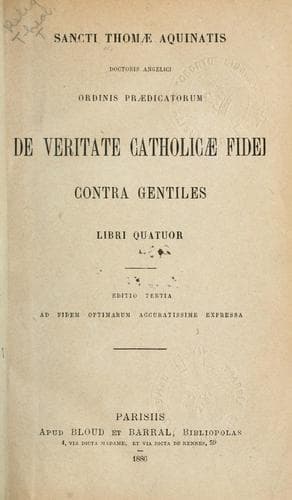
Summa Contra Gentiles
الخلاصة ضد الأمم
Somme contre les Gentils
Reason alone, without appeal to scriptural authority, can demonstrate the existence, unity, and principal attributes of God, and can further show the rational coherence of Christian doctrine against pagan, Jewish, and Islamic objections.
Editorial summary
Thomas Aquinas's Summa Contra Gentiles represents one of the most systematic medieval attempts to establish the existence and nature of God through philosophical reasoning accessible to those outside the Christian faith. Written between 1259 and 1265, this work differs from Aquinas's more famous Summa Theologiae by addressing primarily philosophical rather than theological concerns, making it particularly significant for natural theology and the rational defense of theism.
The work employs a distinctive scholastic-rationalist methodology that proceeds through careful dialectical engagement with opposing views, particularly those of Islamic philosophers like Averroes and Avicenna, as well as ancient Greek thought, especially Aristotle. Aquinas structures his arguments to demonstrate truths about God that he believes can be known through reason alone, without recourse to revelation. This approach reflects the intellectual context of thirteenth-century Europe, where Christian scholars encountered sophisticated Islamic and Jewish philosophical traditions that challenged them to articulate their beliefs in purely rational terms.
Central to the work are Aquinas's developments of cosmological and design arguments. His cosmological reasoning, particularly the argument from motion and the necessity of a first cause, builds upon Aristotelian metaphysics while transforming it for monotheistic purposes. He argues that the existence of contingent beings requires a necessary being whose essence is identical with its existence. The design arguments in the work focus on the order and purposiveness evident in nature, which Aquinas takes as evidence of divine intelligence and providence.
The significance of Summa Contra Gentiles for the God debate lies in its methodological innovation: Aquinas demonstrates that theistic belief can be defended on purely philosophical grounds, establishing a framework that continues to influence natural theology. His careful distinctions between what can be known by reason alone versus what requires revelation set important boundaries for subsequent philosophical theology. The work's engagement with non-Christian philosophical traditions also establishes a model for interfaith philosophical dialogue about God.
Aquinas's arguments in this text have generated extensive commentary and criticism, from medieval scholars through contemporary analytic philosophers. His synthesis of Aristotelian philosophy with monotheistic theology creates a comprehensive metaphysical system that addresses fundamental questions about causation, necessity, and purpose that remain central to philosophical discussions about God's existence and nature.
Argument formulations engaged
Related works
Aquinas, Thomas Summa Contra Gentiles.
@book{summa-contra-gentiles,
  author    = {Aquinas, Thomas},
  title     = {Summa Contra Gentiles},
  year      = {n.d.},
  url       = {https://god-database.com/en/works/summa-contra-gentiles}
}