
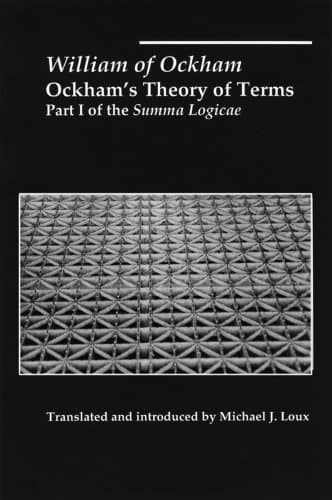
Summa Logicae
خلاصة المنطق
Somme de logique
Editorial summary
William of Ockham's Summa Logicae stands as one of the most influential works in medieval logic and epistemology, with profound implications for theological reasoning and the philosophical approach to divine attributes. Written around 1323, this comprehensive treatise on logic establishes principles that would fundamentally reshape how theologians and philosophers discuss God's nature, knowledge, and relationship to creation.
The work develops Ockham's revolutionary nominalist position, which rejects the real existence of universals outside the mind. This philosophical stance directly challenges the prevailing Thomistic and Scotistic frameworks that had dominated thirteenth-century theology. Where Thomas Aquinas argued for real distinctions between divine attributes and John Duns Scotus proposed formal distinctions, Ockham insists that all such distinctions exist only in human conceptualization. God's simplicity, in Ockham's analysis, means that divine attributes like wisdom, goodness, and power are identical in reality, distinguished only by the limitations of human understanding and language.
Central to the Summa Logicae is Ockham's theory of supposition, which examines how terms function in propositions. This technical analysis has crucial theological applications, particularly regarding how language about God operates. Ockham argues that when predicating terms of God, one must carefully distinguish between their signification and their mode of signifying. Terms borrowed from creatures can truly signify divine perfections, but their creaturely mode of signifying must be recognized as inadequate to divine reality.
The work also advances Ockham's famous "razor" principle, though not explicitly named as such. This methodological commitment to parsimony in explanation influences theological discourse by encouraging simpler accounts of divine action and creation. Rather than positing intermediary forms or species between God and creation, Ockham advocates direct divine causation and knowledge of singulars.
Ockham's logical rigor in the Summa Logicae establishes new standards for theological precision while paradoxically emphasizing the limits of human reason regarding divine mysteries. His nominalism opens space for a more voluntarist theology, emphasizing God's absolute freedom unconstrained by eternal essences or forms. This approach would profoundly influence later medieval thought and Protestant theology, particularly regarding divine sovereignty and the contingency of creation. The work remains essential for understanding the late medieval shift toward more critical and linguistically sophisticated approaches to theological questions.
Argument formulations engaged
Related works
Ockham, William of (1323). Summa Logicae.
@book{summa-logicae-1323,
  author    = {Ockham, William of},
  title     = {Summa Logicae},
  year      = {1323},
  url       = {https://god-database.com/en/works/summa-logicae-1323}
}