
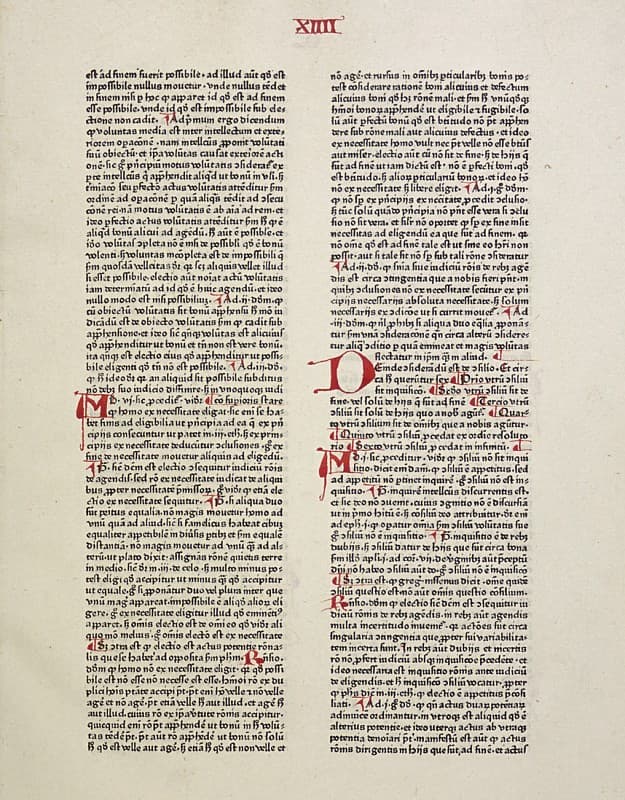
Summa Theologica (unfinished)
الخلاصة اللاهوتية (غير مكتملة)
Somme théologique (inachevée)
Editorial summary
Albert the Great's unfinished Summa Theologica represents a monumental thirteenth-century attempt to synthesize Aristotelian philosophy with Christian theology, establishing methodological foundations that would profoundly influence subsequent scholastic approaches to divine science. Writing at a pivotal moment when newly translated Aristotelian texts were transforming European intellectual life, Albert constructs a systematic theological framework that demonstrates how philosophical reasoning can illuminate revealed truth without compromising either domain's integrity.
The work proceeds through a rigorous dialectical method, addressing fundamental theological questions through the scholastic format of objections, responses, and authoritative citations. Albert's treatment of God's existence, nature, and attributes reveals his distinctive contribution to medieval thought: the conviction that natural philosophy provides essential tools for theological understanding. Unlike contemporaries who viewed Aristotelian naturalism with suspicion, Albert argues that properly understood philosophical principles actually strengthen theological demonstration. His analysis of divine simplicity, for instance, employs Aristotelian metaphysical categories while transcending their limitations to articulate God's absolute unity and perfection.
Albert's theological epistemology navigates carefully between rationalist and fideist extremes. He maintains that while certain truths about God exceed human reason's natural capacity, philosophical investigation can establish preliminary truths that prepare the intellect for revealed knowledge. This position directly challenges both the anti-philosophical stance of certain Franciscan theologians and the radical Aristotelianism emerging in Paris that threatened to subordinate theology to philosophy.
The unfinished state of Albert's Summa paradoxically enhances its historical significance, as it captures scholastic theology in active development rather than crystallized completion. His explorations of divine knowledge, providence, and creation demonstrate sophisticated engagement with Islamic philosophers, particularly Avicenna and Averroes, whose interpretations of Aristotle posed serious challenges to Christian doctrine. Albert's responses reveal a thinker committed to intellectual honesty, acknowledging philosophical difficulties while maintaining theological orthodoxy.
Albert's Summa matters to the God debate because it establishes the possibility of productive dialogue between philosophical reason and religious faith. His methodological innovations, particularly the integration of empirical observation with metaphysical speculation, create space for natural theology within revealed religion. This synthesis would profoundly influence his student Thomas Aquinas, whose own Summa would perfect many approaches Albert pioneered. The work thus stands as a crucial bridge between early medieval theology and the high scholasticism that would dominate university discourse for centuries.
Argument formulations engaged
Related works
Great, Albert the (1274). Summa Theologica (unfinished).
@book{summa-theologica-unfinished-1274,
  author    = {Great, Albert the},
  title     = {Summa Theologica (unfinished)},
  year      = {1274},
  url       = {https://god-database.com/en/works/summa-theologica-unfinished-1274}
}