
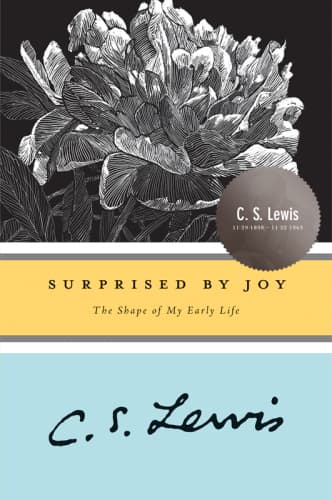
Surprised by Joy: The Shape of My Early Life
مفاجأ بالفرح: شكل حياتي المبكرة
Surpris par la joie : La forme de ma vie précoce
Editorial summary
This autobiographical work traces C.S. Lewis's intellectual and spiritual journey from childhood atheism to Christian belief, offering a detailed phenomenology of conversion that contributes significantly to debates about religious experience and rational belief. Lewis structures his narrative around the recurring experience of "Joy"—an intense longing for something beyond immediate experience that he distinguishes sharply from mere happiness or pleasure. This concept becomes central to his argument for theistic belief, as he presents Joy as a pointer to transcendent reality that naturalistic worldviews cannot adequately explain.
The work engages critically with the materialist and rationalist assumptions that dominated Lewis's early intellectual formation at Oxford. Lewis documents his passage through various philosophical positions—from naive materialism through philosophical idealism to eventual theism and Christianity—presenting each stage as a reasoned response to encountered difficulties rather than mere emotional preference. His account challenges the common atheist narrative that religious belief stems from wishful thinking or intellectual weakness, as Lewis portrays his conversion as occurring despite strong resistance and preference for atheism's perceived intellectual respectability.
Methodologically, Lewis employs introspective analysis combined with literary and philosophical reflection. He draws extensively on his encounters with literature, particularly George MacDonald, G.K. Chesterton, and Norse mythology, arguing that imaginative literature can convey truths about reality that purely rational discourse cannot capture. This approach positions the work against both crude fundamentalism and reductive naturalism, suggesting instead that human aesthetic and spiritual experiences provide valid data for understanding reality's nature.
The text's significance lies in its sophisticated treatment of religious conversion as an intellectual process involving reason, imagination, and experience. Lewis's argument that his experiences of Joy pointed beyond themselves to an objective source provides a phenomenological case for theism that sidesteps traditional natural theology while avoiding pure fideism. His narrative demonstrates how philosophical reflection on lived experience can lead to theistic conclusions, offering a model of reasonable faith that acknowledges both Christianity's intellectual demands and experiential dimensions. The work remains influential in discussions of religious epistemology, particularly regarding the relationship between subjective experience and objective truth claims in religious belief.
Argument formulations engaged
Lewis, C.S. (1955). Surprised by Joy: The Shape of My Early Life. Geoffrey Bles.
@book{surprised-by-joy-the-shape-of-my-early-l,
  author    = {Lewis, C.S.},
  title     = {Surprised by Joy: The Shape of My Early Life},
  year      = {1955},
  publisher = {Geoffrey Bles},
  url       = {https://god-database.com/en/works/surprised-by-joy-the-shape-of-my-early-life-1955}
}