
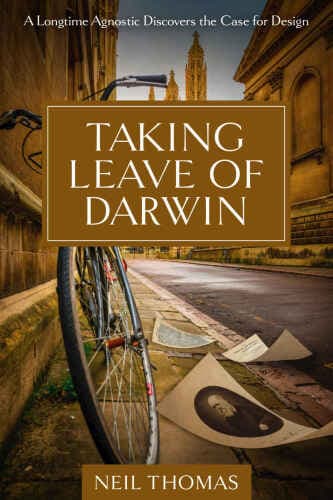
Taking Leave of Darwin: A Longtime Agnostic Discovers the Case for Design
وداعاً داروين: لاأدري منذ أمد بعيد يكتشف الحجة لصالح التصميم
Prendre congé de Darwin : un agnostique de longue date découvre les arguments en faveur du dessein
A longtime agnostic and literary scholar argues that a careful intellectual examination of Darwinian evolutionary theory reveals its philosophical and evidential inadequacies, leading him to embrace the case for intelligent design as the more rationally compelling explanation for biological complexity.
Editorial summary
Neil Thomas's Taking Leave of Darwin represents a significant autobiographical account of intellectual conversion from evolutionary naturalism to design theory. A humanities scholar trained in German studies rather than the natural sciences, Thomas brings a distinctive literary-historical perspective to debates typically dominated by biologists and philosophers of science. The work chronicles his gradual abandonment of Darwinian evolution after decades of unquestioned acceptance, positioning itself as both personal testimony and scholarly critique.
Thomas employs historical-critical methodology to examine the rhetorical strategies and cultural contexts that have sustained neo-Darwinian theory despite what he perceives as mounting evidential challenges. Drawing on his expertise in textual analysis, he scrutinizes Darwin's own writings and those of his successors, arguing that evolutionary theory relies more heavily on metaphorical language and promissory notes than on empirical demonstration. The author particularly emphasizes how Darwin's Victorian-era assumptions about progress and competition shaped the theory's initial formulation and continue to influence its contemporary defenders.
The monograph engages primarily with design arguments, though from an unconventional angle. Rather than beginning with traditional natural theology or intelligent design literature, Thomas describes discovering problems with Darwinism through his own critical reading before encountering design-oriented scholars. He examines specific biological phenomena—including the origin of life, the Cambrian explosion, and the development of consciousness—arguing that naturalistic explanations consistently fall short. His humanities background enables him to identify what he characterizes as category errors in evolutionary reasoning, particularly the attribution of creative powers to natural selection.
Thomas positions his work against what he terms the "Darwinian establishment," critiquing both popular science writers like Richard Dawkins and institutional structures that marginalize design-oriented research. He argues that academic and cultural pressures, rather than scientific evidence, maintain evolutionary theory's dominance. The work contributes to the God debate by suggesting that honest examination of biological complexity leads naturally to design inferences, though Thomas remains somewhat ambiguous about the designer's identity. His journey from agnosticism toward openness to design challenges narratives that present acceptance of evolution as intellectually mandatory for educated moderns, offering instead a model of scholarly reassessment that privileges evidence over consensus.
Structured analysis
Argument formulations engaged
Thomas, Neil Taking Leave of Darwin: A Longtime Agnostic Discovers the Case for Design. Discovery Institute.
@book{taking-leave-of-darwin-a-longtime-agnost,
  author    = {Thomas, Neil},
  title     = {Taking Leave of Darwin: A Longtime Agnostic Discovers the Case for Design},
  year      = {n.d.},
  publisher = {Discovery Institute},
  url       = {https://god-database.com/en/works/taking-leave-of-darwin-a-longtime-agnostic-discovers-the-case-for-design}
}