
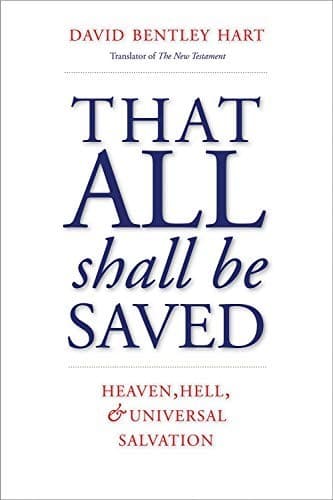
That All Shall Be Saved: Heaven, Hell, and Universal Salvation
أن يخلص الجميع: الجنة والجحيم والخلاص الشامل
Que tous soient sauvés : Paradis, Enfer et Salut universel
Editorial summary
David Bentley Hart's "That All Shall Be Saved" presents a provocative theological argument for universal salvation, challenging the traditional Christian doctrine of eternal damnation. Hart contends that the concept of an eternal hell is philosophically incoherent, morally repugnant, and fundamentally incompatible with core Christian claims about God's nature and purposes. The work represents a significant intervention in contemporary theological debates, combining rigorous philosophical analysis with patristic scholarship and rhetorical force.
Hart structures his argument around three central claims. First, he argues that the traditional doctrine of eternal hell renders creation itself a moral catastrophe, making God complicit in infinite evil. If even one soul suffers eternally, Hart maintains, then God's creative act becomes unjustifiable, transforming the deity into a moral monster. Second, he demonstrates that human freedom, properly understood, cannot coherently choose eternal separation from God, since such a choice would represent a form of insanity rather than genuine liberty. Third, he argues that the biblical texts, when read in their original languages and historical contexts, support universal salvation more strongly than eternal damnation.
The work engages critically with major figures in the theological tradition, particularly Augustine and his influence on Western Christianity's understanding of hell. Hart traces how certain translation choices and theological developments obscured what he sees as the early church's more universalist tendencies. He draws extensively on Gregory of Nyssa, Origen, and other patristic sources to support his reading, while also engaging contemporary defenders of the traditional doctrine.
Methodologically, Hart combines analytic philosophy with classical theology, employing modal logic to demonstrate the incoherence of eternal hell while also offering detailed exegetical arguments. His approach is notably polemical, dismissing opposing views with considerable rhetorical force. This style has generated significant controversy, with critics arguing that Hart misrepresents traditional positions and overstates his case.
The book's significance extends beyond technical theology to broader questions about divine justice, human dignity, and the meaning of religious hope. By arguing that belief in eternal hell corrupts the Christian understanding of God, Hart challenges readers to reconsider fundamental assumptions about divine love, justice, and the ultimate destiny of creation. His work has reignited debates about universalism in contemporary theology and forced fresh examination of how conceptions of the afterlife shape understanding of God's nature.
Argument formulations engaged
Related works
Hart, David Bentley (2019). That All Shall Be Saved: Heaven, Hell, and Universal Salvation. Yale University Press.
@book{that-all-shall-be-saved-heaven-hell-and-,
  author    = {Hart, David Bentley},
  title     = {That All Shall Be Saved: Heaven, Hell, and Universal Salvation},
  year      = {2019},
  publisher = {Yale University Press},
  url       = {https://god-database.com/en/works/that-all-shall-be-saved-heaven-hell-and-universal-salvation-2019}
}