
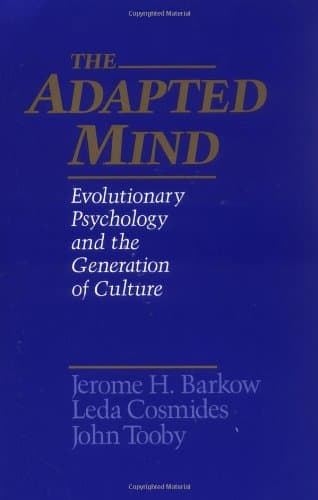
The Adapted Mind: Evolutionary Psychology and the Generation of Culture
العقل المتكيف: علم النفس التطوري وتوليد الثقافة
L'Esprit adapté : Psychologie évolutionniste et génération de culture
Editorial summary
This landmark edited volume marks a foundational moment in evolutionary psychology, establishing how evolved cognitive mechanisms shape human behavior and cultural production. While not explicitly focused on religious questions, the work carries significant implications for understanding religious belief as a natural product of evolved mental architecture.
The volume's editors—Jerome Barkow, Leda Cosmides, and John Tooby—present evolutionary psychology as a unifying framework for understanding the human mind. Their introductory manifesto argues that the mind consists of domain-specific, information-processing mechanisms that evolved to solve adaptive problems faced by hunter-gatherer ancestors. This modular view of cognition challenges blank-slate theories and suggests that cultural phenomena, including religious beliefs, emerge from the interaction between evolved psychological mechanisms and environmental inputs.
Key contributors examine various aspects of human cognition through an adaptationist lens. Cosmides and Tooby's influential chapters on social exchange and cognitive architecture demonstrate how reasoning abilities evolved to handle specific adaptive challenges rather than operating as general-purpose logic machines. Other contributors apply evolutionary analysis to emotions, mate selection, parental investment, and social cooperation—domains that intersect significantly with religious systems.
For the God debate, the volume's importance lies in its naturalistic explanation of mental phenomena traditionally attributed to divine design or cultural construction alone. If human minds possess evolved tendencies toward agency detection, coalition formation, moral intuitions, and meaning-making—as various chapters suggest—then religious beliefs might represent predictable outputs of these mechanisms rather than responses to supernatural realities. The framework implies that the ubiquity of religious belief across cultures reflects common evolved psychology rather than universal spiritual truths.
The work's methodological approach emphasizes reverse-engineering mental mechanisms from their adaptive functions, grounding psychological theories in evolutionary biology. This naturalistic methodology excludes supernatural explanations by default, treating religious cognition as a biological phenomenon requiring scientific rather than theological explanation.
While individual contributors vary in their explicit treatment of religion, the volume's collective impact suggests that evolutionary psychology can explain the origins and persistence of religious belief without reference to actual divine beings. This positions the work within broader scientific challenges to religious worldviews, though its primary focus remains establishing evolutionary psychology as a scientific paradigm rather than directly critiquing theism.
Argument formulations engaged
Related works
Barkow, Jerome H. (1992). The Adapted Mind: Evolutionary Psychology and the Generation of Culture.
@book{the-adapted-mind-evolutionary-psychology,
  author    = {Barkow, Jerome H.},
  title     = {The Adapted Mind: Evolutionary Psychology and the Generation of Culture},
  year      = {1992},
  url       = {https://god-database.com/en/works/the-adapted-mind-evolutionary-psychology-and-the-generation-of-culture-1992}
}