
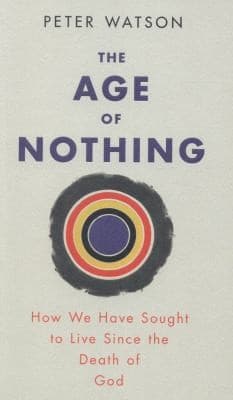
The Age of Nothing
عصر العدم
L'Âge du néant
Editorial summary
Peter Watson's The Age of Nothing presents a sweeping intellectual history of nihilism and the decline of religious belief in Western thought from the 18th century to the present. Watson traces how the erosion of traditional Christian certainties has produced what he terms an "age of nothing" - a cultural condition characterized by the absence of agreed-upon values, meanings, and transcendent purposes. The work examines how successive waves of scientific discovery, philosophical critique, and social transformation have dismantled the religious worldview that once provided coherence to European civilization.
Watson's central argument posits that the death of God, first proclaimed by Nietzsche but prepared by centuries of intellectual development, has left a void that secular ideologies have failed to fill satisfactorily. He charts the emergence of this void through key moments: the Enlightenment's rationalist challenge to revelation, the Romantic reaction that sought meaning in nature and emotion, the devastating impact of Darwinian evolution on teleological thinking, and the horrors of the 20th century that seemed to confirm the absence of providential design. The author demonstrates how attempts to replace religious meaning with political utopias, scientific progress, or aesthetic experience have proven inadequate to the human need for ultimate significance.
The work's method combines intellectual biography with cultural analysis, examining how major thinkers from Voltaire to Sartre have grappled with the implications of a godless universe. Watson pays particular attention to the psychological and social consequences of secularization, arguing that the loss of religious framework has produced not liberation but anxiety, alienation, and moral confusion. He engages critically with New Atheist triumphalism, suggesting that figures like Dawkins and Hitchens underestimate the cultural and existential costs of abandoning religious belief.
Watson's contribution to the God debate lies in his nuanced historical analysis of what the absence of God has meant for Western culture. Rather than advocating for religious revival or celebrating secularization, he provides a diagnostic account of how the decline of theistic belief has shaped modern consciousness. The work serves as a cultural history of atheism's consequences rather than a philosophical argument about God's existence, offering valuable perspective on the practical implications of living in what Charles Taylor calls a "disenchanted" world.
Argument formulations engaged
Watson, Peter (2014). The Age of Nothing. New York University Press.
@book{the-age-of-nothing-2014,
  author    = {Watson, Peter},
  title     = {The Age of Nothing},
  year      = {2014},
  publisher = {New York University Press},
  url       = {https://god-database.com/en/works/the-age-of-nothing-2014}
}