
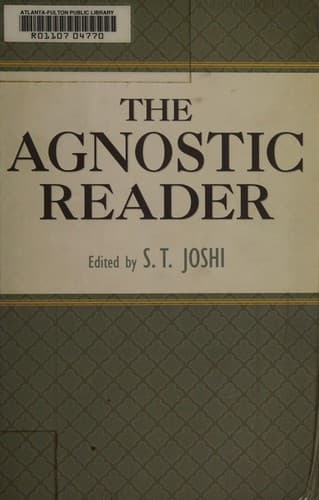
The Agnostic Reader
القارئ اللاأدري
Le lecteur agnostique
Editorial summary
This edited volume assembles key texts from the tradition of philosophical agnosticism, presenting works that challenge both theistic certainty and atheistic conviction. Joshi curates selections from major figures who have articulated the intellectual case for suspending judgment on the existence of God, ranging from ancient skeptics to contemporary philosophers. The collection demonstrates how agnosticism represents not merely indecision but a rigorous epistemological position regarding the limits of human knowledge about ultimate reality.
The volume traces agnosticism's philosophical development through carefully chosen excerpts that illuminate different facets of the position. Classical selections from David Hume establish the empiricist foundations of religious skepticism, while Thomas Huxley's writings articulate the term "agnosticism" itself and defend it as the only scientifically respectable stance toward metaphysical questions. The collection includes Robert Ingersoll's passionate advocacy for freethought, demonstrating how agnosticism intersects with broader movements for intellectual liberty. Leslie Stephen's contributions show how agnostic philosophy engages with ethics and social thought, arguing that morality need not depend on theological foundations.
Joshi's editorial framework emphasizes agnosticism as an active philosophical stance rather than passive uncertainty. The selected texts collectively argue that the evidence for God's existence remains insufficient for rational belief, while simultaneously maintaining that definitive disproof lies beyond human epistemic capacities. This distinguishes philosophical agnosticism from both weak atheism and mere religious indifference. The authors represented share a commitment to proportioning belief to evidence and recognizing the boundaries of empirical investigation when addressing transcendent claims.
The collection's significance lies in establishing agnosticism's intellectual coherence and historical continuity. By gathering these diverse voices, Joshi demonstrates how agnosticism emerges from rigorous engagement with epistemology, science, and ethics rather than from intellectual laziness or spiritual timidity. The volume serves as both historical documentation and philosophical argument, showing how successive thinkers have refined agnostic philosophy in response to both religious apologetics and confident materialism. For contemporary debates about God's existence, the collection provides essential primary sources that complicate simple theist-atheist binaries. It reveals agnosticism as a sophisticated position that takes seriously both the human impulse toward transcendent meaning and the empiricist demand for evidential warrant, refusing to sacrifice either intellectual humility or rational rigor.
Argument formulations engaged
Joshi, S. T. (2007). The Agnostic Reader. Prometheus Books.
@book{the-agnostic-reader-2007,
  author    = {Joshi, S. T.},
  title     = {The Agnostic Reader},
  year      = {2007},
  publisher = {Prometheus Books},
  url       = {https://god-database.com/en/works/the-agnostic-reader-2007}
}