
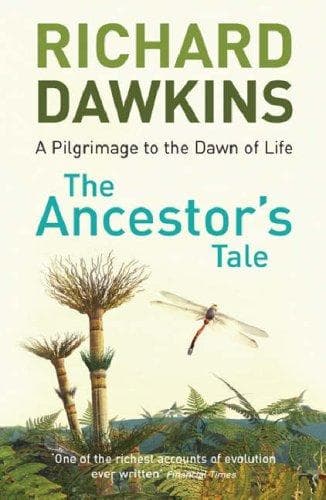
The Ancestors Tale
حكاية الأجداد
Il était une fois nos ancêtres
The evolutionary history of life, traced backward through a grand pilgrimage of common ancestors, demonstrates that the diversity and complexity of living beings are fully explicable by natural selection alone, leaving no explanatory gap for a creator.
Editorial summary
Richard Dawkins's The Ancestor's Tale presents a comprehensive evolutionary narrative that systematically undermines design-based arguments for divine existence while offering naturalistic explanations for religious phenomena. Structured as a reverse chronological journey through evolutionary history, the work traces human ancestry back through 40 "rendezvous points" where lineages converge, ultimately reaching the origin of life itself. This innovative framework allows Dawkins to demonstrate the explanatory power of evolutionary theory across vast timescales while implicitly challenging theistic interpretations of biological complexity.
The monograph engages primarily with two argument families central to the God debate. Against design arguments, Dawkins marshals extensive evidence showing how apparent purposiveness in nature emerges through gradual, undirected processes rather than conscious planning. Each convergence point illustrates how complex features arise through natural selection operating on random variations, rendering divine design superfluous as an explanatory hypothesis. The cumulative effect of these demonstrations significantly weakens traditional natural theology's appeal to biological complexity as evidence for God's existence.
Regarding naturalistic explanations of religion, Dawkins weaves throughout the narrative suggestions about how religious thinking itself evolved. He explores how pattern-seeking behaviors, agency detection, and social cohesion mechanisms that enhanced survival in ancestral environments may have generated religious beliefs as evolutionary byproducts. This approach treats religion not as a response to divine reality but as a natural phenomenon requiring scientific explanation.
Methodologically, Dawkins employs philosophy of science to establish evolution's superiority over theological alternatives. He emphasizes parsimony, predictive power, and empirical testability as criteria distinguishing scientific from religious explanations. The work demonstrates how evolutionary theory meets these standards while design hypotheses fail them, particularly in explaining apparent imperfections and cruelties in nature that seem incongruous with benevolent design.
The Ancestor's Tale's significance lies in its comprehensive integration of evolutionary evidence within a framework explicitly intended to counter religious interpretations of life's diversity. By presenting evolution not merely as compatible with atheism but as rendering theism explanatorily redundant, Dawkins advances a robust form of scientific naturalism. The work functions simultaneously as popular science education and philosophical argument, demonstrating how detailed engagement with biological evidence can inform metaphysical conclusions about divine existence.
Structured analysis
Structure of the work
Argument formulations engaged
Related works
Dawkins, Richard (2004). The Ancestors Tale. Lamp Post.
@book{the-ancestors-tale,
  author    = {Dawkins, Richard},
  title     = {The Ancestors Tale},
  year      = {2004},
  publisher = {Lamp Post},
  url       = {https://god-database.com/en/works/the-ancestors-tale}
}