
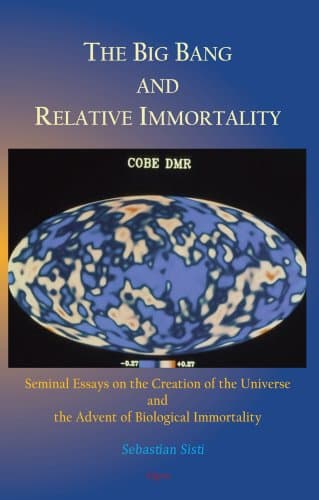
The Big Bang and Relative Immortality
الانفجار العظيم والخلود النسبي
Le Big Bang et l'immortalité relative
The Big Bang and the concept of relative immortality together suggest that cosmological origins and the long-term fate of conscious beings are philosophically intertwined questions demanding a unified speculative framework.
Editorial summary
This monograph examines the intersection of cosmological science and theological questions through a philosophical lens, focusing on how Big Bang theory relates to concepts of temporality, causation, and immortality. Sisti develops a nuanced analysis that moves beyond simple appropriations of scientific cosmology for either theistic or atheistic purposes, instead exploring the conceptual tensions that arise when physics meets metaphysics.
The work engages critically with both traditional cosmological arguments and contemporary fine-tuning discussions. Regarding the former, Sisti demonstrates how Big Bang cosmology both supports and undermines classical first-cause arguments. While the theory posits a temporal beginning that theists have seized upon, the author shows how quantum cosmological models complicate any straightforward causal inference from cosmic origins to divine creation. The analysis reveals how modern physics has transformed the conceptual terrain on which cosmological arguments operate, requiring more sophisticated philosophical frameworks than those inherited from medieval theology.
On fine-tuning, Sisti examines how the apparent calibration of physical constants for life's possibility generates what the author terms "relative immortality" - the notion that conscious observers exist in a cosmic epoch uniquely suited to their emergence and persistence. This concept serves as a bridge between anthropic reasoning and traditional religious concerns about human significance and destiny. The treatment avoids both naive natural theology and reductive materialism, instead mapping the logical space within which fine-tuning observations can be interpreted.
The philosophical methodology employs careful conceptual analysis alongside engagement with technical scientific literature. Sisti demonstrates command of both contemporary cosmology and classical philosophical arguments, using this dual competence to illuminate often-obscured assumptions in popular science-religion debates. The work particularly excels at showing how scientific theories carry implicit metaphysical commitments that shape their theological implications.
The monograph's significance lies in its refusal to collapse complex philosophical questions into simple advocacy for either theism or naturalism. By maintaining analytical distance while seriously engaging both scientific and theological perspectives, Sisti provides tools for more sophisticated dialogue between cosmology and philosophy of religion. The work challenges readers to move beyond proof-texting scientific theories for predetermined theological conclusions, advocating instead for patient philosophical investigation of what our best cosmological theories actually entail for questions about ultimate reality, causation, and human significance in the cosmos.
Structured analysis
Argument formulations engaged
Sisti, Sebastien (2008). The Big Bang and Relative Immortality.
@book{the-big-bang-and-relative-immortality,
  author    = {Sisti, Sebastien},
  title     = {The Big Bang and Relative Immortality},
  year      = {2008},
  url       = {https://god-database.com/en/works/the-big-bang-and-relative-immortality}
}