
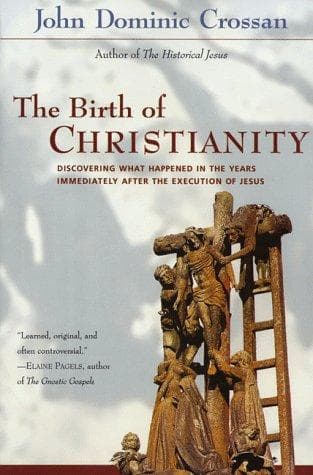
The Birth of Christianity
ولادة المسيحية
La Naissance du christianisme
Editorial summary
This monograph presents a radical historical reconstruction of Christianity's origins that challenges traditional theological narratives about Jesus and the early church. Crossan employs a rigorous interdisciplinary methodology combining cross-cultural anthropology, Greco-Roman history, and literary criticism to examine the social and political dynamics of first-century Palestine. His analysis situates Jesus within the broader context of peasant resistance movements and Jewish renewal programs under Roman imperial domination.
The work's central thesis contends that Christianity emerged not from supernatural intervention but from the intersection of Jewish peasant culture and Mediterranean politics. Crossan argues that the historical Jesus functioned as a Jewish peasant cynic who proclaimed an egalitarian Kingdom of God characterized by open commensality and radical social equality. This vision directly challenged both Roman imperial theology and traditional Jewish hierarchies. The author meticulously distinguishes between the historical figure and subsequent theological interpretations, employing his earlier criteria of multiple attestation and contextual credibility to separate authentic traditions from later ecclesiastical developments.
Significantly, Crossan's reconstruction implies that core Christian claims about Jesus's divine status represent post-Easter theological creativity rather than historical reality. He traces how the early communities transformed Jesus's message of divine justice into narratives of personal divinity, resurrection, and cosmic salvation. This transformation, he argues, served specific social functions within emerging Christian communities as they negotiated their relationship with both Judaism and the Roman Empire.
The work engages critically with both conservative biblical scholarship that assumes historical reliability of gospel narratives and liberal scholarship that remains insufficiently radical in its historical skepticism. Crossan's methodology draws extensively from social-scientific criticism, particularly the anthropological study of peasant societies and honor-shame cultures. His approach builds upon his previous historical Jesus research while expanding the focus to examine how earliest Christianity developed its distinctive theological claims.
For the God debate, this monograph offers a naturalistic account of Christian origins that effectively brackets questions of divine action in history. While Crossan does not explicitly argue against God's existence, his historical method assumes that religious phenomena require purely human explanations. The work demonstrates how seemingly transcendent religious claims can emerge from concrete social and political circumstances, providing implicit support for those who view religious development through entirely naturalistic lenses.
Argument formulations engaged
Related works
Crossan, John Dominic (1998). The Birth of Christianity. HarperCollins.
@book{the-birth-of-christianity-1998,
  author    = {Crossan, John Dominic},
  title     = {The Birth of Christianity},
  year      = {1998},
  publisher = {HarperCollins},
  url       = {https://god-database.com/en/works/the-birth-of-christianity-1998}
}