
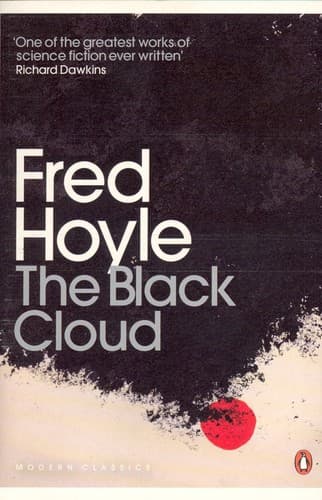
The Black Cloud
السحابة السوداء
Le Nuage noir
A scientifically grounded work of fiction in which contact with a vast intelligent cosmic entity forces a rethinking of the boundaries between science, intelligence, and transcendence.
Editorial summary
Fred Hoyle's science fiction novel "The Black Cloud" (1957, reprinted 2010) presents a unique contribution to the philosophical dialogue about God through the medium of hard science fiction. The narrative follows a group of scientists who discover an immense interstellar cloud approaching Earth, which proves to be a sentient being of extraordinary intelligence. This premise enables Hoyle, a distinguished astrophysicist and cosmologist, to explore fundamental questions about consciousness, intelligence, and the nature of existence without explicit theological framing.
The novel engages substantially with themes relevant to both cosmological and design arguments, though it approaches them obliquely through scientific speculation rather than direct philosophical discourse. Hoyle's cloud entity possesses consciousness that emerged through natural processes over millions of years, presenting an alternative to traditional conceptions of designed intelligence. The being's vast knowledge of cosmic history and its ability to manipulate matter at will raise questions traditionally associated with divine attributes, yet Hoyle grounds these capabilities in naturalistic explanations involving electromagnetic fields and quantum mechanics.
Through dialogues between human scientists and the cloud, Hoyle examines the relationship between intelligence and physical embodiment, the possibility of non-biological consciousness, and the implications of radically different forms of life for human understanding of purpose and meaning in the universe. The cloud's indifference to human concepts of morality and its purely rational approach to existence provide a thought experiment that challenges anthropocentric assumptions often embedded in theological discussions.
The work's significance lies in its demonstration of how scientific imagination can reframe classical philosophical problems. By presenting a naturalistic account of a being with quasi-divine properties, Hoyle invites readers to reconsider the necessity of supernatural explanations for consciousness and cosmic order. The novel exemplifies mid-twentieth-century scientific rationalism while acknowledging the profound mysteries that remain in understanding consciousness and cosmic evolution. Though primarily a work of speculative fiction, it functions as a philosophical meditation on humanity's place in a vast, possibly inhabited universe where intelligence might take forms beyond human comprehension. The narrative method allows Hoyle to explore these themes without committing to explicit philosophical positions, making the work a distinctive contribution to literature that borders on natural theology.
Structured analysis
Argument formulations engaged
Hoyle, Fred (2010). The Black Cloud. New American Library.
@book{the-black-cloud,
  author    = {Hoyle, Fred},
  title     = {The Black Cloud},
  year      = {2010},
  publisher = {New American Library},
  url       = {https://god-database.com/en/works/the-black-cloud}
}