
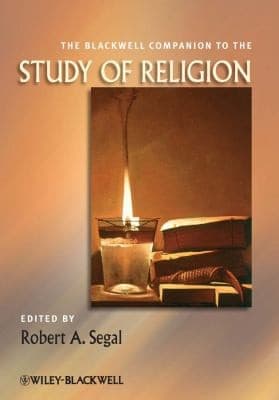
The Blackwell Companion to the Study of Religion
الدليل المرجعي لبلاكويل في دراسة الدين
Le guide Blackwell pour l'étude de la religion
The academic study of religion is best approached through a plurality of disciplinary methods, each illuminating a distinct dimension of religious phenomena without privileging any single theoretical framework.
Editorial summary
The Blackwell Companion to the Study of Religion represents a comprehensive survey of contemporary approaches to religious studies, offering critical assessments of the field's major theoretical frameworks and methodological developments. Edited by Robert Segal, the volume assembles leading scholars to examine how various disciplinary perspectives have shaped the academic study of religion, including its implications for understanding religious conceptions of divinity.
The work adopts an intellectual-historical approach, tracing the evolution of religious studies from its nineteenth-century origins through its current interdisciplinary manifestations. Each chapter examines how different theoretical lenses—from phenomenology and structuralism to cognitive science and postcolonial theory—have approached fundamental questions about religious belief, practice, and experience. This methodological survey proves particularly valuable for understanding how scholarly assumptions about the nature and validity of religious claims have shifted across different academic paradigms.
Segal's editorial framework emphasizes the field's movement away from essentialist definitions of religion toward more contextual and culturally sensitive approaches. The volume demonstrates how early phenomenological attempts to identify universal religious experiences have given way to more particularist analyses that recognize the diversity of religious expressions and their embeddedness in specific social contexts. This shift carries significant implications for how scholars approach truth claims about divine reality, moving from questions of veracity to examinations of function and meaning within particular communities.
The companion's treatment of contemporary debates reveals ongoing tensions between naturalistic and interpretive approaches to religious phenomena. Chapters on cognitive and evolutionary theories of religion present mechanistic explanations for religious belief, while sections on hermeneutics and lived religion emphasize the irreducibility of religious experience to purely material causes. This methodological pluralism reflects broader disciplinary uncertainties about whether religious studies should explain religion scientifically or interpret it sympathetically.
The volume's significance lies in its comprehensive mapping of how different scholarly traditions have conceptualized the study of religion itself, with direct bearing on how academic discourse frames questions about divine reality. By presenting these diverse approaches dialogically rather than advocating for any single method, the work illuminates the contested nature of religious studies as a field and the ongoing debates about appropriate scholarly stances toward religious truth claims. This meta-theoretical perspective proves essential for understanding how academic study shapes contemporary discussions about the existence and nature of God.
Structured analysis
Structure of the work
Argument formulations engaged
Segal, Robert (2006). The Blackwell Companion to the Study of Religion.
@book{the-blackwell-companion-to-the-study-of-,
  author    = {Segal, Robert},
  title     = {The Blackwell Companion to the Study of Religion},
  year      = {2006},
  url       = {https://god-database.com/en/works/the-blackwell-companion-to-the-study-of-religion}
}