
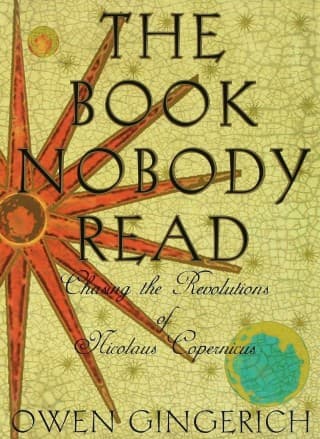
The Book Nobody Read: Chasing the Revolutions of Nicolaus Copernicus
الكتاب الذي لم يقرأه أحد: مطاردة ثورات نيكولاس كوبرنيكوس
Le Livre que personne n'a lu : À la poursuite des révolutions de Nicolas Copernic
Editorial summary
Owen Gingerich's The Book Nobody Read reconstructs the reception history of Copernicus's De revolutionibus through an unprecedented census of surviving copies from the sixteenth century. This bibliographic detective story challenges the conventional narrative that Copernicus's masterwork languished unread until the Scientific Revolution gained momentum. By examining marginalia, annotations, and ownership patterns across nearly 600 extant copies, Gingerich demonstrates that De revolutionibus circulated widely among Europe's mathematical astronomers, who engaged seriously with its technical content even while many rejected its cosmological claims.
The work contributes to understanding how scientific and theological communities negotiated fundamental challenges to the medieval worldview. Gingerich shows that early readers approached Copernicus's heliocentric hypothesis primarily as a computational device rather than a physical reality, revealing how the "saving the phenomena" tradition in astronomy provided conceptual space for radical ideas within orthodox religious frameworks. His analysis of annotation patterns identifies distinct reading communities - from Wittenberg Lutherans who emphasized the mathematical utility while rejecting the physics, to Jesuit astronomers who carefully studied the work despite increasing Catholic opposition.
The study illuminates the complex relationship between scientific innovation and religious authority in early modern Europe. Gingerich traces how De revolutionibus avoided immediate condemnation partly through Andreas Osiander's anonymous preface, which reframed the heliocentric system as merely hypothetical. This editorial intervention, combined with the work's technical difficulty, created interpretive flexibility that allowed diverse readers to appropriate Copernican astronomy for different purposes. The eventual prohibition in 1616, Gingerich argues, resulted less from the book's initial impact than from Galileo's aggressive advocacy of Copernicanism as physical truth.
Methodologically, Gingerich pioneers a material approach to intellectual history, treating books as archaeological artifacts whose physical traces reveal patterns of use and understanding. His census methodology transforms bibliography into cultural history, demonstrating how careful attention to book ownership, marginal notes, and censorship attempts can reconstruct the social networks through which controversial ideas circulated.
While not directly addressing theological questions, Gingerich's work reveals how early modern thinkers navigated the tension between mathematical elegance and scriptural authority. His findings suggest that the supposed conflict between science and religion emerged gradually through contingent historical processes rather than from any inherent incompatibility, offering important context for contemporary debates about the relationship between scientific and religious worldviews.
Argument formulations engaged
Gingerich, Owen (2004). The Book Nobody Read: Chasing the Revolutions of Nicolaus Copernicus.
@book{the-book-nobody-read-chasing-the-revolut,
  author    = {Gingerich, Owen},
  title     = {The Book Nobody Read: Chasing the Revolutions of Nicolaus Copernicus},
  year      = {2004},
  url       = {https://god-database.com/en/works/the-book-nobody-read-chasing-the-revolutions-of-nicolaus-copernicus-2004}
}