
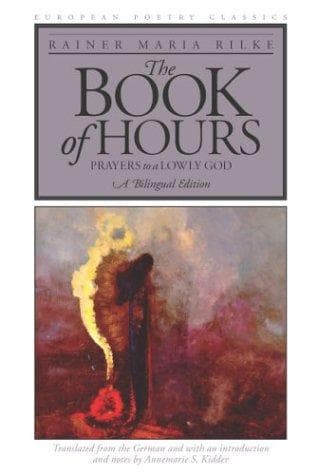
The Book of Hours
كتاب الساعات
Le Livre d'heures
Editorial summary
The Book of Hours represents Rainer Maria Rilke's profound meditation on the nature of divine presence and human spiritual experience. Written between 1899 and 1903 and published in 1905, this collection of devotional poetry reimagines the traditional medieval book of hours through a modern sensibility that resists conventional theological categories. The work consists of three sections chronicling the speaker's evolving relationship with what Rilke calls "the dark God," a deity encountered not through dogma but through intense personal experience.
Rilke's approach diverges sharply from both orthodox Christian theology and the prevailing materialist philosophies of his era. Rather than arguing for God's existence through rational proof or denying divine reality through scientific critique, he presents divinity as an intimate presence discovered through artistic creation and contemplative solitude. The poems depict God not as a transcendent judge but as an immanent force dwelling within human consciousness and the natural world. This conception challenges the stark division between theism and atheism dominating early twentieth-century discourse.
The work's philosophical significance lies in its phenomenological treatment of religious experience. Rilke explores how the divine manifests in moments of creative intensity, suggesting that God exists primarily as a lived reality rather than a metaphysical proposition. His famous line "You are the future, the red sky before sunrise" exemplifies this temporal, experiential understanding of divinity. The poetry presents prayer itself as a creative act that brings God into being through human longing and expression.
Rilke's method combines mystical insight with modernist literary techniques, creating dense symbolic networks that resist systematic interpretation. His God emerges through paradox and negation—simultaneously near and distant, dark and luminous, ancient and perpetually becoming. This approach anticipates later existentialist treatments of religious questions while drawing on medieval mystical traditions, particularly the via negativa of Meister Eckhart.
The Book of Hours contributes to theological discourse by offering an alternative to both traditional theism and reductive naturalism. It suggests that the question of God cannot be answered through abstract argumentation but only through lived experience and creative expression. For contemporary debates about religious meaning in secular contexts, Rilke's work provides a model for discussing divinity that transcends conventional belief-unbelief dichotomies, locating the sacred within human creative capacity itself.
Argument formulations engaged
Rilke, Rainer Maria (1905). The Book of Hours. Camden House.
@book{the-book-of-hours-1905,
  author    = {Rilke, Rainer Maria},
  title     = {The Book of Hours},
  year      = {1905},
  publisher = {Camden House},
  url       = {https://god-database.com/en/works/the-book-of-hours-1905}
}