
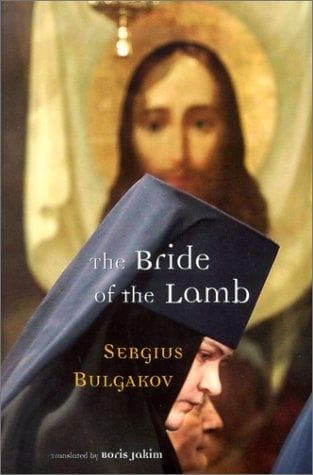
The Bride of the Lamb
عروس الحمل
L'Épouse de l'Agneau
Editorial summary
Sergei Bulgakov's posthumously published "The Bride of the Lamb" (1945) represents the culmination of his sophiological theology and offers a distinctive Orthodox response to modern questions about divine-human relations and eschatology. This monograph completes Bulgakov's major theological trilogy, following "The Lamb of God" and "The Comforter," and advances his controversial doctrine of Sophia as the mediating principle between God and creation.
The work develops Bulgakov's central thesis that Sophia, or Divine Wisdom, constitutes the bridge between the transcendent God and the created order. Against both Western scholastic theology and secular materialism, Bulgakov argues that the cosmos possesses an inherent sophianic structure that enables genuine communion between divine and human natures. He contends that creation is not merely external to God but participates in divine life through Sophia, who appears in both divine and creaturely modes. This sophiological framework allows Bulgakov to reconceptualize traditional doctrines of ecclesiology, anthropology, and eschatology in ways that preserve divine transcendence while affirming creation's ultimate deification.
Methodologically, Bulgakov employs a synthesis of patristic theology, German idealist philosophy, and Russian religious thought. He draws extensively on Eastern Orthodox liturgical and mystical traditions while engaging critically with Western theological categories. His approach challenges the neo-scholastic separation of nature and grace dominant in early twentieth-century theology, proposing instead an integral vision where human nature finds its true fulfillment in sophianic transfiguration.
The monograph's significance lies in its comprehensive vision of theosis or deification as the ultimate destiny of creation. Bulgakov argues against both secular progressivism and apocalyptic pessimism, proposing that history moves toward the full revelation of creation as the Bride of the Lamb. This eschatological vision addresses modern anxieties about meaning and purpose while maintaining traditional Orthodox commitments to divine-human synergy.
"The Bride of the Lamb" matters for contemporary God debates because it offers a maximalist theological vision that neither retreats into fideism nor capitulates to reductionist naturalism. Bulgakov's sophiology provides a framework for understanding divine presence in creation that respects both transcendence and immanence. While his system proved controversial within Orthodoxy and remains contested, it represents a bold attempt to articulate how belief in God can encompass cosmic transformation and human creativity without dissolving into pantheism or mere humanism.
Argument formulations engaged
Bulgakov, Sergei (1945). The Bride of the Lamb.
@book{the-bride-of-the-lamb-1945,
  author    = {Bulgakov, Sergei},
  title     = {The Bride of the Lamb},
  year      = {1945},
  url       = {https://god-database.com/en/works/the-bride-of-the-lamb-1945}
}