
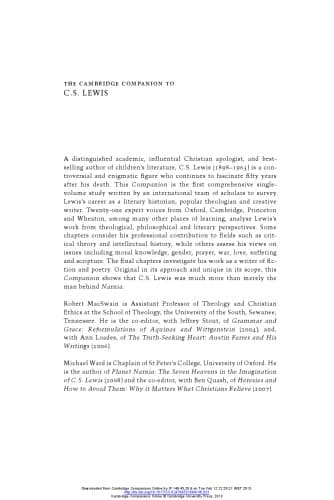
The Cambridge Companion to C. S. Lewis
دليل كامبريدج لسي. إس. لويس
Le compagnon de Cambridge à C. S. Lewis
Editorial summary
This volume assembles leading Lewis scholars to provide comprehensive analysis of C. S. Lewis's intellectual contributions across philosophy, theology, and literature. The collection examines how Lewis developed sophisticated arguments for Christian theism while engaging skeptical modern thought through both academic discourse and popular imagination.
The work explores Lewis's distinctive apologetic method, which combined rigorous philosophical argumentation with imaginative literature. Contributors analyze how Lewis addressed fundamental questions about God's existence, the problem of evil, miracles, and religious experience. Several chapters examine his argument from reason, which contends that naturalistic materialism undermines the validity of human reasoning itself, thereby providing indirect support for theism. The volume traces how Lewis refined this argument throughout his career, responding to critics while maintaining that rational thought requires grounding in a divine Mind.
Central attention focuses on Lewis's moral argument for God's existence. Contributors explicate his claim that objective moral values point beyond naturalistic explanations to a transcendent source. The collection examines how Lewis developed this position through engagement with ethical subjectivism and moral relativism, arguing that universal human experiences of moral obligation require theistic foundations. Several chapters analyze how his fictional works, particularly the Narnia chronicles and space trilogy, embody these philosophical arguments in narrative form.
The volume situates Lewis within 20th century religious thought, examining his relationships with contemporaries like J. R. R. Tolkien, Charles Williams, and Dorothy Sayers. Contributors assess his critique of modern reductionism and scientism, showing how he defended religious belief against positivist dismissals while acknowledging legitimate scientific findings. The work explores tensions in Lewis's thought, including his views on other religions, biblical interpretation, and theological doctrines like hell and atonement.
Peterson's collection demonstrates Lewis's enduring relevance to contemporary philosophy of religion. Contributors analyze how Lewis anticipated current debates about consciousness, morality, and rationality. The volume reveals a thinker who combined analytical rigor with imaginative power, offering reasoned defenses of Christian theism that engaged seriously with opposing viewpoints. By examining both Lewis's scholarly works and popular writings, this companion illuminates how philosophical arguments about God can reach diverse audiences through multiple genres while maintaining intellectual integrity.
Argument formulations engaged
Related works
Peterson, Michael L. (2010). The Cambridge Companion to C. S. Lewis. Cambridge University Press.
@book{the-cambridge-companion-to-c-s-lewis-201,
  author    = {Peterson, Michael L.},
  title     = {The Cambridge Companion to C. S. Lewis},
  year      = {2010},
  publisher = {Cambridge University Press},
  url       = {https://god-database.com/en/works/the-cambridge-companion-to-c-s-lewis-2010}
}