
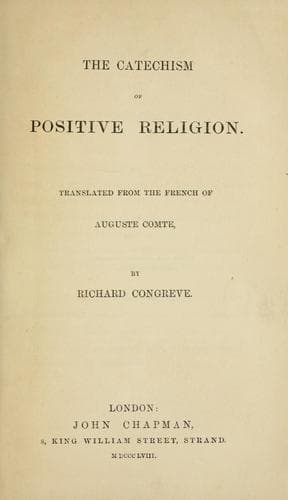
The Catechism of Positive Religion
تعليم الدين الوضعي
Le Catéchisme de la religion positive
Editorial summary
Auguste Comte's Catechism of Positive Religion (1852) represents the culmination of his systematic attempt to establish a new religious framework entirely divorced from theological foundations. Written in the form of dialogues between a woman and a Priest of Humanity, this work articulates Comte's vision for replacing traditional theistic religion with a scientifically grounded worship of humanity itself.
The text systematically develops Comte's Religion of Humanity, which emerged from his broader positivist philosophy. Comte argues that human intellectual development progresses through three stages: the theological, the metaphysical, and the positive or scientific. Having diagnosed contemporary society as transitioning from the metaphysical to the positive stage, Comte proposes that traditional concepts of God must give way to the veneration of Humanity as the "Great Being." This substitution represents not merely an intellectual shift but a comprehensive reorganization of religious sentiment and practice.
Comte's method combines systematic philosophy with detailed prescriptions for ritual and social organization. He constructs an elaborate calendar of commemorations, sacraments marking life stages, and prescribed forms of worship, all centered on humanity rather than any transcendent deity. The work demonstrates his conviction that religion's social and emotional functions can be preserved while eliminating its supernatural content. Against both traditional theists and secular rationalists who would abandon religion entirely, Comte positions himself as offering a middle path that satisfies human needs for meaning, community, and moral guidance without recourse to metaphysical speculation.
The Catechism's significance lies in its radical reconceptualization of religion itself. Rather than arguing for or against God's existence, Comte sidesteps the question entirely, treating it as belonging to an outmoded stage of human development. His work influenced subsequent secular humanist movements and contributed to sociological approaches to religion that focus on its social functions rather than its truth claims. The text also reveals the paradoxical nature of Comte's project: while rejecting traditional religion as primitive, he meticulously recreates its institutional and ritual structures, suggesting that the religious impulse itself transcends particular theological commitments. This tension between Comte's anti-theological stance and his preservation of religious forms continues to generate debate about the nature and future of religion in secular societies.
Argument formulations engaged
Comte, Auguste (1852). The Catechism of Positive Religion. Cambridge University Press.
@book{the-catechism-of-positive-religion-1852,
  author    = {Comte, Auguste},
  title     = {The Catechism of Positive Religion},
  year      = {1852},
  publisher = {Cambridge University Press},
  url       = {https://god-database.com/en/works/the-catechism-of-positive-religion-1852}
}