
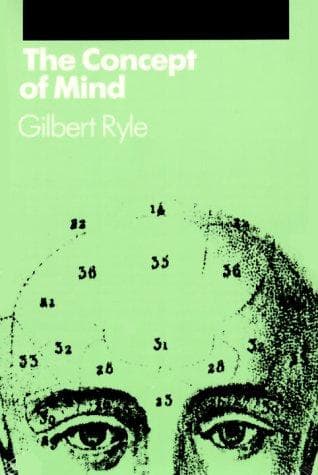
The Concept of Mind
مفهوم العقل
Le Concept d'esprit
Editorial summary
Gilbert Ryle's "The Concept of Mind" (1949) revolutionizes philosophical discourse about consciousness through its systematic demolition of Cartesian dualism. While not explicitly addressing theological questions, the work profoundly impacts debates about divine minds, souls, and religious experience by dismantling the conceptual framework underlying traditional theistic anthropology.
Ryle attacks what he famously terms "the ghost in the machine" - the Cartesian notion that minds are immaterial substances inhabiting physical bodies. Through meticulous ordinary language analysis, he demonstrates that mental concepts do not refer to mysterious inner states but to patterns of behavior and dispositions. When someone acts intelligently, no ghostly mental occurrence precedes the action; rather, the intelligent behavior itself constitutes what we mean by intelligence. This behaviorist approach dissolves numerous philosophical puzzles by showing they rest on category mistakes - treating dispositional concepts as if they named occurrent events or substances.
The work's theological implications emerge through its treatment of consciousness and personhood. Traditional Christian doctrine relies heavily on substance dualism to explain the soul's immortality, divine-human interaction, and religious experience. Ryle's analysis undermines these doctrines by denying the coherence of immaterial substances altogether. If minds are not things but ways of acting, then souls cannot survive bodily death, God cannot be a disembodied super-mind, and religious experiences cannot involve direct contact between immaterial spirits.
Ryle employs a distinctly British philosophical method, combining Wittgensteinian attention to ordinary usage with systematic conceptual cartography. His arguments proceed through careful analysis of how mental terms function in everyday discourse, revealing that dualist interpretations violate the logic of our actual concepts. This approach influences subsequent philosophy of religion by demanding that theological claims respect the grammar of mental concepts.
The monograph's enduring significance lies in shifting the burden of proof onto dualists and, by extension, traditional theists. After Ryle, defenders of souls, divine minds, or spiritual substances must explain how their positions avoid category mistakes. While Ryle himself remains largely silent on theological matters, his conceptual framework forces religious thinkers to either abandon substantial souls or develop new ways of articulating mind-body relations that escape his critique. The work thus indirectly advances naturalistic worldviews by dismantling conceptual supports for supernatural mental entities.
Argument formulations engaged
Related works
Ryle, Gilbert (1949). The Concept of Mind. University of Chicago Press.
@book{the-concept-of-mind-1949,
  author    = {Ryle, Gilbert},
  title     = {The Concept of Mind},
  year      = {1949},
  publisher = {University of Chicago Press},
  url       = {https://god-database.com/en/works/the-concept-of-mind-1949}
}