
Editorial summary
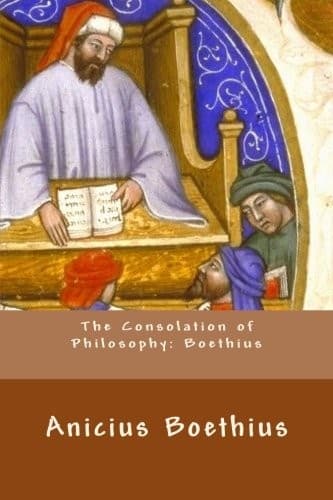
Boethius's "The Consolation of Philosophy" stands as one of the most influential texts in medieval thought, composed while the author awaited execution in prison. The work presents a philosophical dialogue between Boethius and Lady Philosophy, who appears to console him in his distress. Through this literary device, Boethius explores fundamental questions about divine providence, human freedom, the nature of evil, and the relationship between God and temporal fortune.
The text advances a sophisticated synthesis of Platonic and Aristotelian philosophy within a broadly theistic framework, though notably without explicit Christian doctrine. Lady Philosophy guides Boethius through a series of arguments designed to demonstrate that true happiness resides not in worldly goods—wealth, honor, power, or pleasure—but in the supreme good, which she identifies with God. This supreme good represents the perfect unity of all genuine goods, possessing complete self-sufficiency and serving as the source of all being.
Boethius develops a complex theodicy addressing the apparent injustice of virtuous suffering and wicked prosperity. Philosophy argues that divine providence orders all things toward good, while fate represents the temporal unfolding of this eternal plan. The work's most challenging section treats the compatibility of divine foreknowledge with human free will. Boethius proposes that God perceives all temporal events in an eternal present, thus possessing certain knowledge of future contingents without thereby necessitating them. This solution, distinguishing between simple and conditional necessity, profoundly influenced subsequent medieval debates.
The methodological approach combines rigorous logical argumentation with Neoplatonic metaphysics. Boethius employs both prose and verse, with the metrical passages serving to crystallize philosophical insights achieved through dialectical reasoning. The work systematically refutes Epicurean, Stoic, and Manichean positions while establishing a metaphysical hierarchy culminating in divine unity.
The Consolation's significance for the God debate extends beyond its specific arguments. By demonstrating philosophy's capacity to address ultimate questions through natural reason alone, Boethius provided medieval thinkers with a model for rational theology. His treatment of providence, divine simplicity, and eternal perspective shaped centuries of philosophical theology. The work's influence appears in Aquinas, Dante, and Chaucer, among others. Its synthesis of philosophical rigor with existential concern established a template for addressing the problem of evil and divine justice that remains relevant to contemporary philosophical theology.
Argument formulations engaged
Related works
Boethius (524). The Consolation of Philosophy. The Project Gutenberg EBook.
@book{the-consolation-of-philosophy-524,
  author    = {Boethius},
  title     = {The Consolation of Philosophy},
  year      = {524},
  publisher = {The Project Gutenberg EBook},
  url       = {https://god-database.com/en/works/the-consolation-of-philosophy-524}
}