
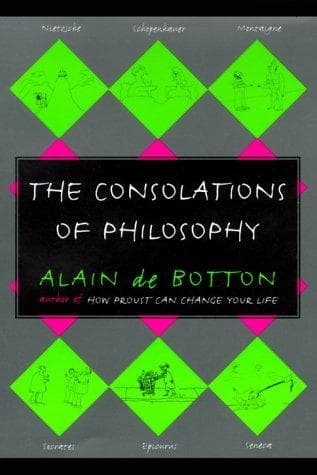
The Consolations of Philosophy
عزاءات الفلسفة
Les Consolations de la philosophie
Editorial summary
The Consolations of Philosophy offers a popular reinterpretation of classical philosophical wisdom for contemporary secular audiences, demonstrating how ancient thinkers addressed perennial human anxieties without recourse to religious frameworks. De Botton selects six philosophers spanning antiquity to modernity—Socrates, Epicurus, Seneca, Montaigne, Schopenhauer, and Nietzsche—presenting their ideas as practical remedies for common afflictions: unpopularity, poverty, frustration, inadequacy, heartbreak, and difficulties.
The work operates within a distinctly secular humanist framework, positioning philosophy as an alternative to religious consolation. De Botton's method involves translating complex philosophical arguments into accessible narratives, illustrated with personal anecdotes, historical vignettes, and contemporary applications. This approach reflects his broader project of reclaiming traditionally religious functions—comfort, meaning-making, community—for secular culture. The text implicitly argues that philosophical reflection can fulfill the emotional and psychological needs often addressed by religious belief, without requiring metaphysical commitments.
Regarding the God question, the book maintains a consistent naturalistic stance. While not explicitly atheistic in argumentation, it proceeds from the assumption that meaningful consolation must derive from human reason rather than divine revelation. De Botton's selection of philosophers reinforces this orientation: Epicurus's materialism, Schopenhauer's pessimistic atheism, and Nietzsche's proclamation of God's death all challenge religious worldviews. Even when discussing more ambiguous figures like Seneca or Montaigne, de Botton emphasizes their rational, this-worldly wisdom over any theological dimensions of their thought.
The work contributes to contemporary debates about post-religious meaning by exemplifying what Charles Taylor terms "exclusive humanism"—the conviction that human flourishing requires no transcendent reference point. De Botton's popularizing approach, while criticized by academic philosophers for oversimplification, reaches audiences seeking alternatives to religious consolation. His emphasis on philosophy as therapy echoes ancient traditions while addressing modern secular anxieties about mortality, purpose, and suffering.
The text's significance lies less in original philosophical argumentation than in its cultural positioning. It participates in the broader movement to construct secular alternatives to religious institutions and practices, suggesting that classical philosophy contains sufficient resources for addressing existential concerns traditionally managed by religious traditions. This project assumes rather than argues for naturalism, making it representative of contemporary popular philosophy's predominantly secular orientation.
Argument formulations engaged
Botton, Alain de (2000). The Consolations of Philosophy.
@book{the-consolations-of-philosophy-2000,
  author    = {Botton, Alain de},
  title     = {The Consolations of Philosophy},
  year      = {2000},
  url       = {https://god-database.com/en/works/the-consolations-of-philosophy-2000}
}