
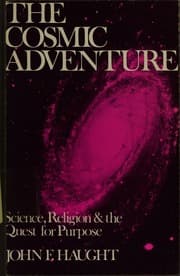
The Cosmic Adventure: Science, Religion and the Quest for Purpose
المغامرة الكونية: العلم والدين والسعي للغرض
L'Aventure cosmique : Science, religion et la quête du sens
Editorial summary
This monograph represents John F. Haught's systematic attempt to reconcile evolutionary science with religious purpose through process theology. Writing in the wake of renewed science-religion tensions in the 1980s, Haught develops a theological framework that embraces rather than resists scientific cosmology and evolutionary theory.
The work's central argument challenges both scientific materialism and religious fundamentalism by proposing that God operates through evolutionary processes rather than despite them. Haught draws heavily on Alfred North Whitehead's process philosophy and Teilhard de Chardin's evolutionary mysticism to construct a theology that views the universe as an ongoing creative adventure in which God participates as a lure toward greater complexity and consciousness. Against reductionist scientists who see evolution as purposeless, Haught argues that the universe displays a directional tendency toward increased organization and awareness. Against biblical literalists who reject evolution, he contends that divine creativity works precisely through the mechanisms science discovers.
Methodologically, Haught employs a synthetic approach that weaves together scientific findings, philosophical analysis, and theological reflection. He engages critically with both neo-Darwinian evolutionists like Jacques Monod and Stephen Jay Gould, who emphasize chance and contingency, and with conservative theologians who view evolution as threatening divine sovereignty. His response involves reconceptualizing God not as a distant designer but as the source of novelty and possibility within natural processes.
The monograph's significance lies in its articulation of a "third way" between scientific atheism and anti-scientific theism. Haught's process perspective offers religious believers a means of accepting scientific discoveries while maintaining belief in cosmic purpose and divine presence. He argues that understanding God as the ultimate source of the universe's creative advance actually provides a more profound theology than traditional design arguments. The work particularly addresses the problem of theodicy by suggesting that an evolving universe necessarily involves struggle and suffering as part of its creative transformation.
This contribution proves influential in subsequent science-religion dialogue by demonstrating how theological concepts can be reformulated rather than abandoned in light of scientific knowledge. Haught's vision of God as working through rather than interrupting natural processes provides a model for theological engagement with science that neither compromises scientific integrity nor reduces religious meaning to metaphor. The work thus offers both a critique of reductionist interpretations of evolution and a constructive theological alternative.
Argument formulations engaged
Haught, John F. (1984). The Cosmic Adventure: Science, Religion and the Quest for Purpose. Paulist Press.
@book{the-cosmic-adventure-science-religion-an,
  author    = {Haught, John F.},
  title     = {The Cosmic Adventure: Science, Religion and the Quest for Purpose},
  year      = {1984},
  publisher = {Paulist Press},
  url       = {https://god-database.com/en/works/the-cosmic-adventure-science-religion-and-the-quest-for-purpose-1984}
}