
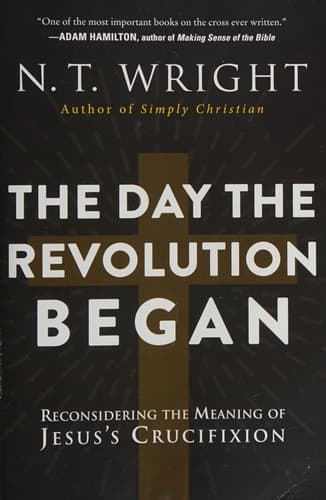
The Day the Revolution Began
اليوم الذي بدأت فيه الثورة
Le Jour où la révolution a commencé
Editorial summary
This monograph advances a comprehensive reinterpretation of Christian atonement theology, arguing that traditional understandings have fundamentally misrepresented the biblical narrative of Jesus's crucifixion. Wright contends that mainstream Christianity has reduced the cross to a mechanism for individual soul salvation, missing its revolutionary political and cosmic dimensions. He traces this reductionism to medieval satisfaction theories and Reformation-era forensic models, which he argues distort the New Testament's actual claims about divine action in history.
Wright's central thesis posits that Jesus's death inaugurated nothing less than a new creation, overthrowing the powers that enslave humanity and establishing God's kingdom on earth. He challenges both conservative evangelical and liberal Protestant readings, asserting that the former overemphasize personal sin while the latter minimize the cross's salvific significance. His exegetical method combines historical-critical analysis with canonical theological interpretation, drawing extensively on Second Temple Jewish sources to reconstruct the worldview within which early Christians understood Jesus's death.
The work engages critically with major atonement theories from Anselm through Gustaf Aulén, while particularly targeting contemporary evangelical formulations that Wright sees as importing foreign philosophical categories into biblical interpretation. He argues that penal substitution models reflect pagan rather than Jewish thought patterns, proposing instead that the cross represents God's climactic covenant faithfulness, defeating the dark powers that corrupt creation and liberating humanity for genuine worship and vocation.
Wright's constructive proposal emphasizes the cross as the moment when Israel's representative Messiah exhausts the power of sin and death, enabling renewed human vocation as divine image-bearers. This interpretation integrates individual transformation within a larger narrative of cosmic redemption, presenting salvation as participation in God's project of new creation rather than escape from material existence. The work connects this theological vision to contemporary questions about social justice, political power, and ecological responsibility, arguing that properly understanding the cross reshapes Christian engagement with worldly structures.
The monograph's significance lies in its attempt to reconnect atonement theology with biblical eschatology and ethics, challenging both academic theology and popular Christianity to reconsider fundamental assumptions about salvation's meaning and scope. Wright's influence extends across denominational boundaries, sparking renewed debate about how divine action relates to human history and destiny.
Argument formulations engaged
Related works
Wright, N. T. (2016). The Day the Revolution Began. SPCK / HarperOne.
@book{the-day-the-revolution-began-2016,
  author    = {Wright, N. T.},
  title     = {The Day the Revolution Began},
  year      = {2016},
  publisher = {SPCK / HarperOne},
  url       = {https://god-database.com/en/works/the-day-the-revolution-began-2016}
}