
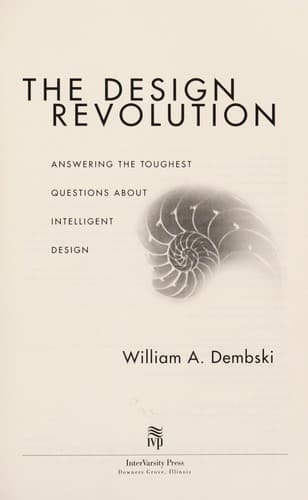
The Design Revolution.. Answering the Toughest Questions About Intelligent Design
ثورة التصميم.. الإجابة عن أصعب الأسئلة حول التصميم الذكي
La Révolution du dessein.. Répondre aux questions les plus difficiles sur le dessein intelligent
Intelligent Design is a scientifically and philosophically legitimate research program, not a disguised religious argument, because specified complexity and irreducible complexity constitute genuine empirical markers of design that Darwinian mechanisms cannot account for.
Editorial summary
William Dembski's "The Design Revolution" presents a systematic defense of intelligent design theory as a legitimate scientific and philosophical framework for understanding biological complexity. Writing within the Christian apologetic tradition, Dembski addresses what he identifies as the most challenging objections to intelligent design, positioning his work as both a response to critics and a positive case for design inference in nature.
The monograph employs an apologetic-synthetic methodology, combining mathematical, philosophical, and theological arguments to construct a comprehensive defense of design theory. Dembski structures his work around forty-four questions commonly raised by opponents, ranging from methodological concerns about the scientific status of intelligent design to substantive critiques of its explanatory power. This question-and-answer format serves both pedagogical and polemical purposes, allowing Dembski to anticipate and counter objections while building his positive case.
Central to Dembski's argument is his concept of "specified complexity," which he presents as a reliable marker of intelligent causation. He contends that certain features of biological systems exhibit patterns that cannot be adequately explained by undirected natural processes, particularly Darwinian mechanisms of random variation and natural selection. Drawing on information theory and probability calculus, Dembski argues that the presence of specified complexity in biological systems points necessarily to intelligent design.
The work engages directly with the contemporary design and fine-tuning argument families, updating classical teleological reasoning with modern scientific and mathematical insights. Dembski positions intelligent design as distinct from traditional creationism, emphasizing its focus on empirical detection of design rather than biblical interpretation. He challenges the methodological naturalism that he sees as artificially constraining scientific inquiry, arguing that science should follow evidence wherever it leads, even if that means inferring intelligent causation.
Throughout the text, Dembski responds to prominent critics including Richard Dawkins, Kenneth Miller, and Michael Ruse, addressing their scientific, philosophical, and theological objections. He defends intelligent design against charges of being unscientific, religiously motivated, or explanatorily vacuous. The work represents a significant contribution to early twenty-first century debates about evolution, design, and the relationship between science and religion, articulating a sophisticated version of design theory that continues to influence discussions about biological origins and the limits of naturalistic explanation.
Structured analysis
Argument formulations engaged
Related works
Dembski, William (2004). The Design Revolution.. Answering the Toughest Questions About Intelligent Design. IVP Books.
@book{the-design-revolution-answering-the-toug,
  author    = {Dembski, William},
  title     = {The Design Revolution.. Answering the Toughest Questions About Intelligent Design},
  year      = {2004},
  publisher = {IVP Books},
  url       = {https://god-database.com/en/works/the-design-revolution-answering-the-toughest-questions-about-intelligent-design}
}