
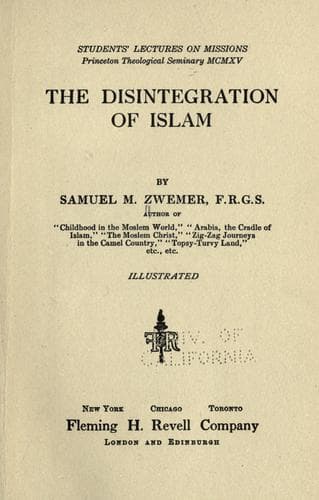
The Disintegration of Islam
تفكك الإسلام
La Désintégration de l'Islam
Editorial summary
Samuel M. Zwemer's "The Disintegration of Islam" presents an early twentieth-century Christian missionary perspective on what the author perceives as Islam's inevitable decline in the face of modernization and Christian evangelization. Writing from his position as a prominent Reformed Church missionary with extensive experience in the Middle East, Zwemer constructs an argument that Islam lacks the theological and intellectual resources necessary to withstand the pressures of modern scientific thought, democratic ideals, and Christian truth claims.
The work employs a polemical methodology characteristic of missionary literature from this period, combining field observations with theological critique to argue that Islam represents an inherently unstable religious system. Zwemer contends that Islamic monotheism, while superior to polytheism, remains fundamentally flawed due to its rejection of Christian doctrines of incarnation and trinity. He presents Islam as caught between its medieval theological framework and the demands of modern life, suggesting this tension will inevitably lead to its dissolution.
Central to Zwemer's thesis is his claim that educated Muslims increasingly recognize contradictions within Islamic scripture and tradition when exposed to Western education and biblical criticism. He interprets various reform movements within Islam not as signs of vitality but as symptoms of internal crisis, arguing that attempts to modernize Islamic thought merely accelerate its disintegration by highlighting its supposed inadequacies. The author particularly emphasizes what he sees as Islam's inability to provide satisfactory answers to questions of divine love, human redemption, and personal relationship with God.
The monograph engages primarily with nineteenth-century Orientalist scholarship while positioning itself against Islamic theological claims about divine revelation and prophetic authority. Zwemer's work reflects the confidence of Western Christian missions during the colonial period, assuming both the superiority of Christian civilization and the eventual triumph of Christianity over other world religions. His analysis treats Islam not as a legitimate theological alternative but as a deficient system awaiting replacement by Christian truth.
While dated in its triumphalist tone and colonial assumptions, the work remains significant for understanding early twentieth-century Christian missionary attitudes toward Islam and the intellectual framework within which Christian-Muslim theological encounters occurred during this period. It exemplifies how the God debate was conducted across religious boundaries in an era of Western imperial expansion and missionary optimism.
Argument formulations engaged
Zwemer, Samuel M. (1916). The Disintegration of Islam.
@book{the-disintegration-of-islam-1916,
  author    = {Zwemer, Samuel M.},
  title     = {The Disintegration of Islam},
  year      = {1916},
  url       = {https://god-database.com/en/works/the-disintegration-of-islam-1916}
}