
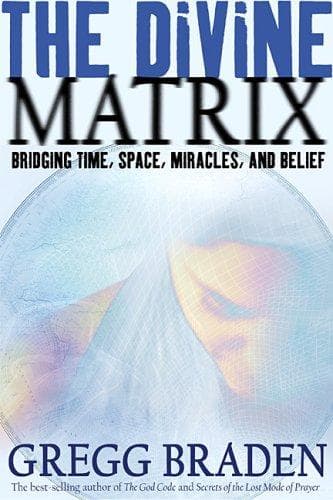
The Divine Matrix
المصفوفة الإلهية
La Matrice divine
Editorial summary
Gregg Braden's The Divine Matrix presents a synthesis of quantum physics, consciousness studies, and spiritual traditions to argue for the existence of an interconnected field of energy that underlies all reality. This work positions itself within the broader discourse on science and spirituality, attempting to bridge empirical research with metaphysical claims about divine presence in the universe.
Braden constructs his argument around the concept of the "Divine Matrix," which he describes as a living energy field connecting all things. Drawing on quantum entanglement experiments, the observer effect in physics, and research on human consciousness, he contends that modern science provides evidence for what ancient spiritual traditions have long claimed: that a unified field of consciousness permeates existence. The author particularly emphasizes experiments in quantum mechanics that demonstrate non-local connections between particles, interpreting these findings as scientific validation of spiritual interconnectedness.
The work engages critically with materialist reductionism in mainstream science, challenging the view that consciousness emerges solely from brain activity. Braden argues instead for consciousness as a fundamental property of the universe itself, embedded within the Divine Matrix. He presents this field as responsive to human thought and emotion, suggesting that individuals can influence reality through focused intention and belief. This positions the work against strictly mechanistic interpretations of physics while aligning with various New Age and alternative spirituality movements.
Methodologically, Braden employs a popular science approach, translating complex physics concepts for general audiences while weaving in examples from healing practices, prayer studies, and personal anecdotes. He draws parallels between quantum phenomena and spiritual experiences, using scientific terminology to legitimize metaphysical claims. The work references experiments from institutions like the Institute of HeartMath and cites physicists such as Max Planck and David Bohm to support its thesis.
The Divine Matrix contributes to the God debate by offering a panentheistic vision where divinity is understood not as a separate transcendent being but as the very fabric of reality itself. This perspective attempts to reconcile scientific materialism with spiritual experience, proposing that consciousness and intentionality are built into the structure of the universe. While the work has found resonance among readers seeking scientific validation for spiritual beliefs, it remains controversial within academic circles for its interpretive leaps from quantum mechanics to metaphysical conclusions.
Argument formulations engaged
Braden, Gregg (2007). The Divine Matrix. Hay House.
@book{the-divine-matrix-2007,
  author    = {Braden, Gregg},
  title     = {The Divine Matrix},
  year      = {2007},
  publisher = {Hay House},
  url       = {https://god-database.com/en/works/the-divine-matrix-2007}
}