
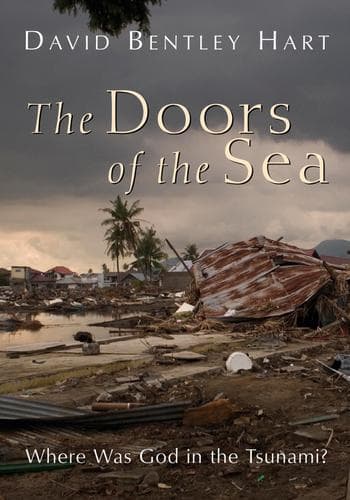
The Doors of the Sea: Where Was God in the Tsunami?
أبواب البحر: أين كان الله في التسونامي؟
Les Portes de la mer : Où était Dieu dans le tsunami ?
Editorial summary
This slender but philosophically dense monograph emerges from Hart's visceral response to the 2004 Indian Ocean tsunami and the theological questions it raised. Hart confronts what he perceives as inadequate Christian responses to natural evil, particularly those that attempt to discern divine purpose in catastrophic suffering. His work operates simultaneously as a defense of classical theism and a sharp critique of certain strands of contemporary theodicy.
Hart's central argument distinguishes between the world as God intends it and the world as it currently exists in its fallen state. He draws heavily on Eastern Orthodox theology, particularly the patristic tradition, to argue that natural disasters represent not God's will but rather the groaning of a creation subjected to futility. Against both atheistic critics who see suffering as evidence against God's existence and Christians who interpret disasters as divine punishment or pedagogy, Hart maintains that such events manifest creation's bondage to decay rather than divine intention.
The work engages critically with several theological positions. Hart reserves particular criticism for what he terms "metaphysical optimism" - theodicies that attempt to justify every instance of suffering as serving some greater good. He challenges Reformed theologians who emphasize divine sovereignty to the point of making God the author of evil, as well as process theologians who limit divine power to preserve divine goodness. His sharpest rhetoric targets Christians who offered simplistic explanations for the tsunami, seeing in their responses a betrayal of authentic Christian teaching about evil's ultimate meaninglessness.
Methodologically, Hart combines philosophical analysis with rhetorical force, moving between technical theological argumentation and passionate moral appeal. He grounds his position in the early church fathers, especially Gregory of Nyssa and Maximus the Confessor, while engaging contemporary thinkers like Kenneth Surin and Terrence Tilley. His approach reflects both analytic precision and the apophatic tradition's emphasis on divine mystery.
The monograph's significance lies in its attempt to articulate a theodicy that neither diminishes the reality of suffering nor compromises divine goodness. Hart argues that only an eschatological framework - one that looks to God's final victory over evil rather than seeking present justifications - can adequately address natural evil while maintaining orthodox Christian commitments. This work has influenced subsequent discussions of theodicy, particularly among theologians seeking alternatives to both atheistic critiques and inadequate religious responses to suffering.
Argument formulations engaged
Related works
Hart, David Bentley (2005). The Doors of the Sea: Where Was God in the Tsunami?. Eerdmans.
@book{the-doors-of-the-sea-where-was-god-in-th,
  author    = {Hart, David Bentley},
  title     = {The Doors of the Sea: Where Was God in the Tsunami?},
  year      = {2005},
  publisher = {Eerdmans},
  url       = {https://god-database.com/en/works/the-doors-of-the-sea-where-was-god-in-the-tsunami-2005}
}