
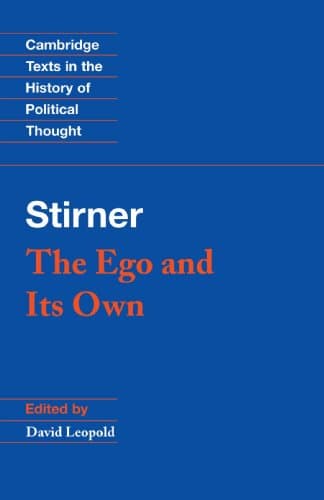
The Ego and Its Own
الأنا وملكيتها
L'Ego et sa propriété
Editorial summary
Stirner's "The Ego and Its Own" presents a radical philosophical assault on all forms of transcendent authority, including and especially the concept of God. Writing in the context of Young Hegelian debates about religion and human essence, Stirner develops an extreme form of egoism that rejects not only traditional theism but also the humanistic substitutes proposed by his contemporaries, particularly Ludwig Feuerbach.
The work's central argument proceeds through a systematic demolition of what Stirner terms "fixed ideas" or "spooks" - abstract concepts that individuals allow to dominate their thinking and behavior. God represents the paramount example of such a spook, an imaginary entity to which humans subordinate themselves. Stirner traces how religious consciousness creates a fundamental alienation: individuals project their own power onto a divine being, then prostrate themselves before their own creation. This critique extends beyond conventional theism to encompass any form of sacred value or absolute principle.
Stirner's method combines philosophical analysis with psychological insight, examining how religious thinking patterns persist even in ostensibly secular philosophies. He argues that Feuerbach's humanism, which replaces God with "Man" or "Humanity," merely substitutes one idol for another. The Feuerbachian critique of religion remains incomplete because it preserves the structure of worship and subordination, merely redirecting it toward a collective abstraction. Similarly, Stirner identifies religious patterns in political ideologies, moral systems, and philosophical concepts that claim absolute validity.
The work's contribution to debates about God lies in its uncompromising rejection of all forms of transcendence. While other critics of religion sought to preserve some higher values or principles, Stirner insists that the individual ego alone possesses reality and value. His philosophy dissolves the very framework within which traditional God-debates occur, rejecting not just particular answers but the legitimacy of the questions themselves.
Stirner's influence extends through various intellectual traditions, from anarchism to existentialism. His radical critique anticipates later discussions about the death of God and the psychology of religious belief. By exposing how purportedly secular worldviews can function as surrogate religions, Stirner's analysis remains relevant to contemporary debates about meaning, value, and authority in post-religious contexts. His work represents perhaps the most extreme position in 19th century philosophy regarding the rejection of divine and quasi-divine authorities.
Argument formulations engaged
Related works
Stirner, Max (1845). The Ego and Its Own. Cambridge University Press.
@book{the-ego-and-its-own-1845,
  author    = {Stirner, Max},
  title     = {The Ego and Its Own},
  year      = {1845},
  publisher = {Cambridge University Press},
  url       = {https://god-database.com/en/works/the-ego-and-its-own-1845}
}