
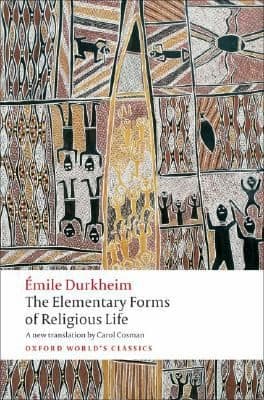
The Elementary Forms of Religious Life
الأشكال الأولية للحياة الدينية
Les Formes élémentaires de la vie religieuse
Editorial summary
Durkheim's The Elementary Forms of Religious Life represents a foundational contribution to the sociological study of religion that fundamentally reframes the God debate by shifting focus from metaphysical questions to social functions. Writing against both theological defenses of religion and rationalist dismissals, Durkheim argues that religion constitutes an irreducibly social phenomenon whose essence lies not in beliefs about supernatural beings but in the distinction between sacred and profane realms that all societies maintain.
The work examines Australian Aboriginal totemism as the most "elementary" religious form, employing ethnographic data from Spencer, Gillen, and others to construct a general theory of religion's origin and persistence. Durkheim contends that religious symbols and rituals do not represent imaginary beings but rather embody society itself in transfigured form. The totem simultaneously symbolizes both the god and the clan because the god is nothing other than the clan's collective force experienced as external and transcendent. This analysis leads to his famous formulation that in worshipping gods, humans unknowingly worship their own social group.
Methodologically, Durkheim pioneers a thoroughly naturalistic approach that explains religion without reference to supernatural realities while avoiding reductionist accounts that dismiss religious phenomena as mere illusion. He argues against contemporary anthropologists like Tylor and Frazer who interpreted religion as primitive science, insisting instead that religion addresses fundamentally different human needs than empirical knowledge. The work also challenges psychological theories reducing religion to individual experience, demonstrating through extensive ethnographic analysis how religious categories emerge from collective assemblies and ritual practices.
The significance for debates about God lies in Durkheim's radical reconceptualization of religious truth. Rather than asking whether God exists metaphysically, he investigates why all societies generate conceptions of the sacred and what social functions these serve. Religion becomes eternally necessary not because supernatural beings exist but because societies require symbolic systems to represent their unity and moral authority. This sociological framework transforms theological questions into empirical investigations of how communities create and sustain their gods through ritual practice. The work thus offers neither proof nor disproof of God's existence but rather a scientific explanation for why humans invariably construct religious systems, suggesting that as long as society exists, some form of the sacred will persist, even if traditional theistic beliefs decline.
Argument formulations engaged
Durkheim, Émile (1912). The Elementary Forms of Religious Life. The Free Press.
@book{the-elementary-forms-of-religious-life-1,
  author    = {Durkheim, Émile},
  title     = {The Elementary Forms of Religious Life},
  year      = {1912},
  publisher = {The Free Press},
  url       = {https://god-database.com/en/works/the-elementary-forms-of-religious-life-1912}
}