
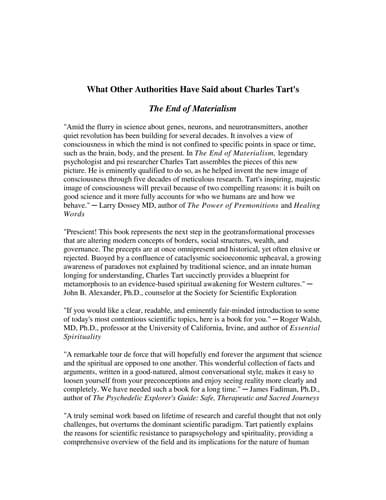
The End of Materialism
نهاية المادية
La Fin du matérialisme
Scientific materialism cannot account for a substantial body of well-documented parapsychological evidence, and taking that evidence seriously requires a broader, more open conception of mind and reality.
Editorial summary
Charles Tart's "The End of Materialism" presents a comprehensive challenge to scientific materialism's dismissal of spiritual phenomena, arguing that rigorous empirical investigation of parapsychological experiences reveals fundamental limitations in materialist accounts of consciousness. Drawing on decades of laboratory research and his background as both a psychologist and consciousness researcher, Tart contends that the accumulated evidence for telepathy, clairvoyance, precognition, psychokinesis, and psychic healing cannot be explained away through conventional materialist frameworks.
The work operates primarily through philosophy of science methodology, examining how scientific paradigms shape the interpretation of anomalous data. Tart critiques what he terms "scientism" - the ideological extension of scientific method that a priori excludes phenomena incompatible with materialist assumptions. He argues that genuine scientific inquiry must remain open to evidence regardless of its implications for prevailing worldviews. The text systematically reviews experimental parapsychology research, emphasizing studies with robust methodological controls and statistically significant results that have been replicated across laboratories.
Central to Tart's argument is the claim that consciousness exhibits properties irreducible to neural activity. He presents parapsychological phenomena as empirical challenges to physicalism, suggesting they demonstrate consciousness operating beyond conventional spatial and temporal constraints. While not explicitly arguing for theism, Tart proposes that these findings support a "spiritual" dimension to human existence, which he carefully distinguishes from traditional religious doctrine. His approach emphasizes compatibility between rigorous scientific investigation and openness to transcendent aspects of human experience.
The monograph engages significantly with the consciousness argument by using paranormal phenomena as evidence against reductive materialism. Tart's cumulative case draws together diverse experimental findings to argue that the weight of evidence demands reconsidering fundamental assumptions about reality's nature. He positions his work against prominent materialist philosophers and scientists who dismiss parapsychological research, arguing their rejection stems from philosophical commitment rather than evidential assessment.
The significance of Tart's contribution lies in its attempt to bridge empirical psychology and spiritual inquiry through scientific methodology. By insisting that anomalous phenomena deserve serious scientific attention, he challenges both dogmatic materialism and uncritical spiritualism. The work represents an important voice in debates about consciousness, scientific methodology, and the relationship between empirical investigation and metaphysical questions, offering a model for how scientific inquiry might approach phenomena traditionally excluded from materialist frameworks.
Structured analysis
Argument formulations engaged
Tart, Charles (2009). The End of Materialism.
@book{the-end-of-materialism,
  author    = {Tart, Charles},
  title     = {The End of Materialism},
  year      = {2009},
  url       = {https://god-database.com/en/works/the-end-of-materialism}
}