
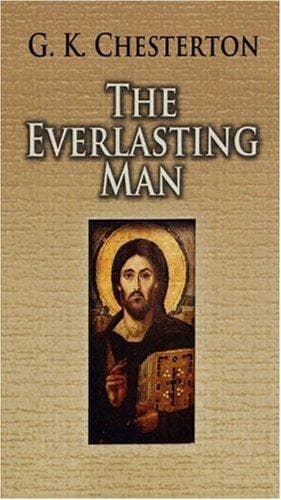
The Everlasting Man
الإنسان الأبدي
L'Homme éternel
Christianity is not merely one religion among many but the singular fulfillment of humanity's deepest longings, and Christ is not a myth but a unique historical figure whose life shatters all naturalistic and comparative-religion reductions.
Editorial summary
Gilbert Keith Chesterton's The Everlasting Man presents a sweeping historical-philosophical defense of Christianity through a narrative reconstruction of human history that challenges the naturalistic evolutionary accounts prevalent in early twentieth-century thought. Writing against figures like H.G. Wells and the comparative religionists of his day, Chesterton constructs a two-part argument that first examines humanity's radical distinctiveness from the animal kingdom, then traces the unique trajectory of Christianity against the backdrop of pagan religions.
The work's central thesis contends that both humanity and Christianity represent fundamental discontinuities in the natural order that cannot be explained through gradualist evolutionary schemas. Chesterton argues that the appearance of cave art, symbolism, and religious consciousness marks not merely a quantitative development but a qualitative leap that separates humans categorically from their supposed evolutionary predecessors. This anthropological argument serves as the foundation for his broader theological claim that Christianity similarly represents a unique irruption into history rather than one religion among many.
Methodologically, Chesterton employs what might be termed imaginative reasoning, inviting readers to step outside familiar conceptual frameworks and perceive supposedly well-known phenomena with fresh eyes. He deploys historical narrative not as mere chronicle but as philosophical argument, suggesting that the shape of history itself reveals design and purpose. His approach anticipates later design arguments by highlighting the apparent fine-tuning of historical circumstances that made both human consciousness and the Christian revelation possible.
The text engages critically with the reductionist tendencies of comparative mythology and evolutionary anthropology, arguing that these approaches flatten crucial distinctions and miss the genuine novelty of both human nature and the Incarnation. Against scholars who would dissolve Christianity into mystery cults or derive human consciousness from animal behavior, Chesterton maintains that honest observation reveals irreducible uniqueness in both cases.
The work's enduring significance lies in its challenge to naturalistic assumptions about religious development and human origins. By arguing that Christianity's historical particularity constitutes evidence for rather than against its truth claims, Chesterton reverses common apologetic strategies. His emphasis on the philosophical implications of historical patterns and the evidential value of human consciousness continues to influence contemporary design arguments and discussions of divine action in history.
Argument formulations engaged
Related works
Chesterton, G. K. The Everlasting Man. Philosophy Documentation Center.
@book{the-everlasting-man,
  author    = {Chesterton, G. K.},
  title     = {The Everlasting Man},
  year      = {n.d.},
  publisher = {Philosophy Documentation Center},
  url       = {https://god-database.com/en/works/the-everlasting-man}
}