
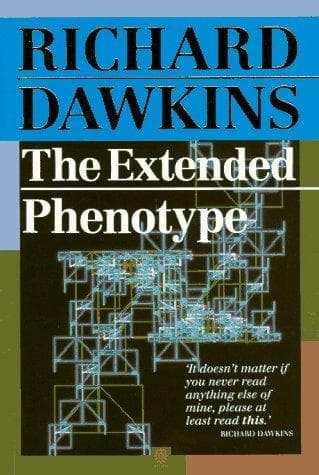
The Extended Phenotype
النمط الظاهري الممتد
Le Phénotype étendu
The gene-centred, extended view of natural selection provides a fully naturalistic framework that renders any appeal to design or transcendent agency explanatorily superfluous.
Editorial summary
The Extended Phenotype represents Richard Dawkins' most sophisticated contribution to evolutionary theory, with significant implications for debates about divine design in nature. Building on his gene-centered view of evolution from The Selfish Gene, Dawkins argues that genes influence not only the bodies of organisms but extend their effects into the environment through behavior, artifacts, and even the manipulation of other organisms. This conceptual expansion fundamentally challenges teleological interpretations of biological phenomena that have historically supported design arguments.
Dawkins demonstrates that apparently purposeful biological arrangements need not imply conscious design or foresight. By showing how genes can produce complex effects beyond organism boundaries—from beaver dams to parasitic manipulation of host behavior—he undermines the intuition that intricate adaptations require an intelligent designer. The work systematically dismantles the appearance of purpose in nature that has long served as evidence for divine creation, replacing it with a mechanistic account of how blind evolutionary processes generate functional complexity.
The monograph engages directly with natural theology's design argument, though often implicitly rather than through explicit theological critique. Dawkins' philosophy of science methodology reveals how gene-level selection accounts for phenomena that might otherwise seem to require supernatural explanation. His treatment of parasitic relationships particularly challenges benevolent design interpretations, as he details how natural selection produces arrangements that appear cruel or wasteful from a human perspective but make perfect sense as outcomes of competing genetic interests.
Within the naturalistic explanation of religion framework, The Extended Phenotype provides conceptual tools for understanding religious behaviors and beliefs as potential extended phenotypic effects of either genes or memes. Though not the work's primary focus, this implication suggests that religious phenomena themselves might be products of evolutionary processes rather than responses to divine reality.
The work's significance for the God debate lies in its systematic expansion of naturalistic explanation. By demonstrating how genes create effects that transcend individual organisms, Dawkins extends the reach of mechanistic explanation into domains previously thought to require teleological or divine accounts. His rigorous application of gene-centered thinking to diverse biological phenomena strengthens the atheistic position that complex, apparently designed features of the natural world emerge from mindless evolutionary processes rather than conscious creation.
Structured analysis
Argument formulations engaged
Related works
Dawkins, Richard (1982). The Extended Phenotype. Oxford University Press, USA.
@book{the-extended-phenotype,
  author    = {Dawkins, Richard},
  title     = {The Extended Phenotype},
  year      = {1982},
  publisher = {Oxford University Press, USA},
  url       = {https://god-database.com/en/works/the-extended-phenotype}
}