
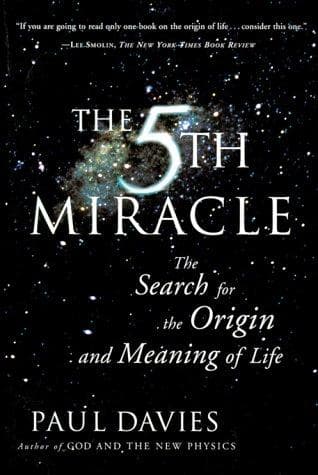
The Fifth Miracle: The Search for the Origin and Meaning of Life
المعجزة الخامسة: البحث عن أصل الحياة ومعناها
Le Cinquième Miracle : La Recherche de l'Origine et du Sens de la Vie
Editorial summary
Paul Davies's "The Fifth Miracle" examines the origin of life through the lens of contemporary physics and biology, arguing that life's emergence represents a fundamental principle of cosmic organization rather than a chance occurrence. Davies positions this work within broader debates about teleology and design in nature, directly engaging with both mechanistic reductionism and traditional theistic design arguments.
The monograph develops what Davies terms "biological determinism" - the thesis that life emerges inevitably from the laws of physics under appropriate conditions. He distinguishes this position from both strict mechanistic accounts that reduce life to mere chemistry and from supernatural design arguments. Davies argues that information processing, not merely complex chemistry, defines life, and that the universe's fundamental laws are peculiarly suited to generate information-processing systems. This leads him to propose that life represents a "fifth miracle" alongside the four fundamental forces of physics, suggesting a deep connection between biological organization and cosmic structure.
Davies's methodology combines theoretical physics with emerging research in astrobiology and complexity theory. He draws particularly on quantum mechanics and information theory to argue that conventional reductionist approaches cannot fully explain biological organization. His analysis of extremophiles and the possibility of life in extreme environments serves to strengthen his case that life emerges through fundamental principles rather than contingent circumstances. The work engages critically with both neo-Darwinian orthodoxy and intelligent design theory, seeking a middle path that acknowledges life's apparent directedness without invoking supernatural intervention.
The significance of Davies's contribution lies in his sophisticated attempt to naturalize teleology - to explain apparent purpose in nature through physical laws rather than divine action. While rejecting traditional theistic design arguments, he equally challenges purely mechanistic accounts that deny any inherent directedness in cosmic evolution. His concept of "bio-friendliness" built into physical laws offers a scientifically respectable alternative to both crude materialism and supernatural design.
The work matters for the God debate because it demonstrates how contemporary science can address questions traditionally reserved for theology without defaulting to either reductive materialism or theistic supernaturalism. Davies's position suggests that the universe's capacity to generate life and consciousness might reflect deeper principles of organization that science has yet to fully comprehend, keeping open questions about ultimate meaning while working within naturalistic frameworks.
Argument formulations engaged
Related works
Davies, Paul (1999). The Fifth Miracle: The Search for the Origin and Meaning of Life. Simon & Schuster.
@book{the-fifth-miracle-the-search-for-the-ori,
  author    = {Davies, Paul},
  title     = {The Fifth Miracle: The Search for the Origin and Meaning of Life},
  year      = {1999},
  publisher = {Simon & Schuster},
  url       = {https://god-database.com/en/works/the-fifth-miracle-the-search-for-the-origin-and-meaning-of-life-1999}
}