
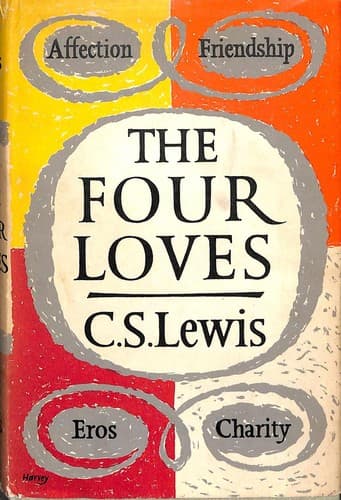
The Four Loves
المحبات الأربع
Les Quatre Amours
Editorial summary
This monograph examines the nature of love through a Christian theological lens, arguing that human experiences of love ultimately point toward and find their fulfillment in divine love. Lewis categorizes love into four distinct types: affection (storge), friendship (philia), romantic love (eros), and charity (agape). His central thesis maintains that while the first three loves constitute natural human experiences, they achieve their proper ordering and ultimate significance only when subordinated to and transformed by agape, which Lewis identifies as divine love operating through human beings.
The work engages critically with both secular reductionist accounts that treat love as merely biological or psychological phenomena and with religious perspectives that denigrate natural loves as inherently corrupt. Against the former, Lewis argues that the very existence of love in its various forms suggests a transcendent source and purpose that naturalistic explanations cannot adequately address. Against the latter, he contends that natural loves serve as divinely ordained preparations for understanding and receiving God's love, though they require proper ordering to avoid becoming idolatrous.
Lewis employs a phenomenological method, drawing extensively on literature, personal observation, and classical sources to analyze how each type of love manifests in human experience. He demonstrates how each natural love contains both a tendency toward divine charity and a propensity for distortion when pursued as an ultimate end. His analysis reveals that eros points beyond itself to union with the divine, friendship reflects the communal nature of heavenly life, and affection mirrors God's care for creation.
The monograph's significance for discussions about God lies in its sophisticated natural theology of love. Lewis presents human experiences of love not as proofs for God's existence but as phenomena that remain incomplete and ultimately unintelligible without reference to divine love. His argument suggests that the universal human capacity for and need for love constitutes a kind of existential pointer toward God. The work challenges both purely naturalistic accounts of human emotion and overly spiritualized rejections of embodied human experience, proposing instead an integrated vision where natural and supernatural loves exist in hierarchical harmony. This approach offers a distinctive contribution to theistic philosophy by grounding arguments for God's reality in concrete human experiences while avoiding both sentimentalism and rationalistic abstraction.
Argument formulations engaged
Lewis, C.S. (1960). The Four Loves. Geoffrey Bles.
@book{the-four-loves-1960,
  author    = {Lewis, C.S.},
  title     = {The Four Loves},
  year      = {1960},
  publisher = {Geoffrey Bles},
  url       = {https://god-database.com/en/works/the-four-loves-1960}
}