
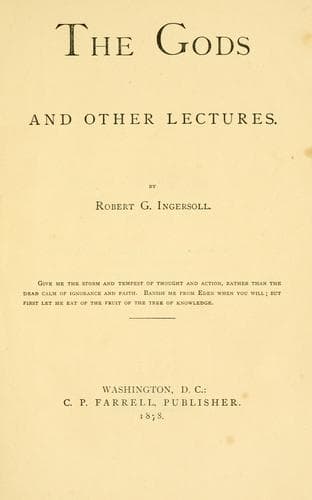
The Gods and Other Lectures
الآلهة ومحاضرات أخرى
Les Dieux et Autres Conférences
Editorial summary
Robert G. Ingersoll's "The Gods and Other Lectures" represents a foundational text in 19th-century American freethought and secularism. This collection of essays systematically dismantles religious orthodoxy through a combination of rational argumentation, historical criticism, and rhetorical flourish that made Ingersoll one of the most celebrated orators of his era.
The work's central thesis contends that religious belief stems from primitive ignorance rather than divine revelation. Ingersoll traces the evolution of deity concepts from polytheistic nature worship to monotheistic abstraction, arguing that gods merely reflect human fears and aspirations projected onto an indifferent universe. He employs comparative mythology to demonstrate parallels between Christianity and earlier pagan systems, suggesting that biblical narratives represent recycled myths rather than historical truth.
Ingersoll's method combines Enlightenment rationalism with emerging scientific materialism. He draws heavily on contemporary biblical criticism, particularly German higher criticism, while incorporating Darwinian evolution to explain religious phenomena naturalistically. His approach anticipates later anthropological theories of religion while maintaining accessibility for popular audiences. The essays particularly target Protestant fundamentalism and Catholic authoritarianism, which Ingersoll views as impediments to human progress and individual liberty.
The collection's significance extends beyond theological critique to encompass broader social reform. Ingersoll connects religious orthodoxy with political oppression, arguing that supernatural beliefs legitimate earthly tyrannies. He advocates for church-state separation, women's rights, and intellectual freedom as necessary corollaries of rejecting divine authority. This linkage between secularism and progressive politics would profoundly influence subsequent American freethought movements.
The work's rhetorical strategy employs humor, pathos, and moral indignation to undermine religious authority. Ingersoll transforms biblical criticism from dry scholarship into compelling public discourse, making skepticism emotionally appealing rather than merely intellectually convincing. His emphasis on human dignity and earthly happiness as superior to theological abstractions resonates with pragmatic American sensibilities.
"The Gods and Other Lectures" remains significant for understanding the development of organized atheism in America. It demonstrates how religious criticism evolved from deistic compromise to explicit atheistic advocacy during the late 19th century. The work's combination of scholarly argumentation with popular appeal established a template for public atheism that continues to influence contemporary secular movements.
Argument formulations engaged
Related works
Ingersoll, Robert G. (1876). The Gods and Other Lectures. Barnes & Noble.
@book{the-gods-and-other-lectures-1876,
  author    = {Ingersoll, Robert G.},
  title     = {The Gods and Other Lectures},
  year      = {1876},
  publisher = {Barnes & Noble},
  url       = {https://god-database.com/en/works/the-gods-and-other-lectures-1876}
}