
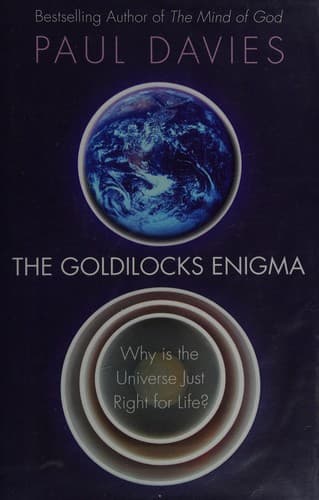
The Goldilocks Enigma: Why Is the Universe Just Right for Life?
لغز المعتدلة: لماذا الكون مناسب تماماً للحياة؟
L'Énigme Boucle d'Or : Pourquoi l'Univers est-il Parfait pour la Vie ?
Editorial summary
Paul Davies examines the remarkable fine-tuning of physical constants and laws that permit the existence of life in the universe, exploring various explanations for what he terms the "Goldilocks enigma" - the observation that cosmic conditions appear "just right" for biological complexity. The work synthesizes recent developments in cosmology, physics, and astrobiology to address one of science's most profound puzzles: why the universe possesses precisely the properties necessary for life to emerge and evolve.
Davies systematically analyzes the extraordinary precision required in fundamental constants such as the strength of nuclear forces, the cosmological constant, and the initial conditions following the Big Bang. He demonstrates that even minute variations in these parameters would render the universe sterile - devoid of stars, chemistry, or stable matter. This fine-tuning problem has become increasingly acute as physicists have discovered more examples of apparent cosmic coincidences that seem essential for habitability.
The work evaluates multiple explanatory frameworks for this phenomenon. Davies examines the multiverse hypothesis, which posits countless universes with varying properties, making our life-friendly cosmos statistically inevitable through selection effects. He also considers the anthropic principle in its various formulations, from weak versions that merely acknowledge observational selection bias to stronger claims about necessity or design. Traditional theistic design arguments receive careful analysis, as do more exotic possibilities including cosmic evolution through "baby universes" and the controversial notion that observers somehow participate in determining physical laws.
Davies distinguishes his approach through its scientific rigor while maintaining openness to metaphysical implications. He critiques both dogmatic materialism that dismisses the fine-tuning as mere coincidence and simplistic design arguments that invoke divine intervention. Instead, he advocates for recognizing the genuine mystery while pursuing naturalistic explanations that might transcend current physics.
The monograph's significance lies in its comprehensive treatment of fine-tuning from a respected physicist who avoids both reductionist dismissal and premature theological conclusions. Davies argues that the Goldilocks enigma represents a fundamental challenge to scientific materialism's completeness, suggesting that understanding why the universe is bio-friendly may require new conceptual frameworks that integrate physical law with the possibility of life and mind. His work has influenced subsequent debates about multiverse theories, the anthropic principle, and the relationship between cosmic fine-tuning and questions of ultimate purpose or design.
Argument formulations engaged
Related works
Davies, Paul (2006). The Goldilocks Enigma: Why Is the Universe Just Right for Life?. Allen Lane.
@book{the-goldilocks-enigma-why-is-the-univers,
  author    = {Davies, Paul},
  title     = {The Goldilocks Enigma: Why Is the Universe Just Right for Life?},
  year      = {2006},
  publisher = {Allen Lane},
  url       = {https://god-database.com/en/works/the-goldilocks-enigma-why-is-the-universe-just-right-for-life-2006}
}