
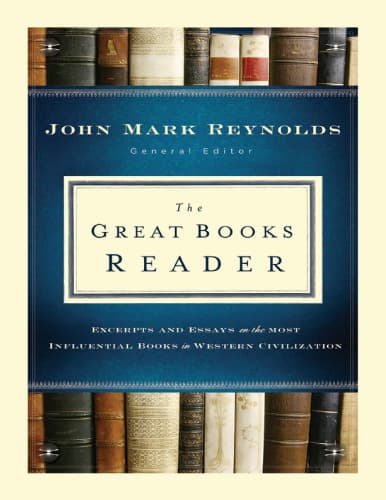
The Great Books Reader: Excerpts and Essays on the Most Influential Books in Western Civilization
قارئ الكتب العظيمة: مقتطفات ومقالات عن أكثر الكتب تأثيراً في الحضارة الغربية
Le Lecteur des Grands Livres : Extraits et Essais sur les Livres les Plus Influents de la Civilisation Occidentale
Editorial summary
This comprehensive anthology assembles key passages from canonical texts spanning three millennia of Western thought, accompanied by contemporary scholarly commentary. Reynolds structures the volume chronologically, moving from ancient Greek philosophy through medieval theology to modern literature and philosophy, with particular attention to works that have shaped debates about divine existence, human nature, and ultimate meaning.
The collection's theological orientation becomes evident through its selection criteria and editorial framing. While including skeptical voices like Lucretius and Hume, Reynolds privileges texts from the Christian intellectual tradition, featuring extensive excerpts from Augustine, Aquinas, Dante, and Pascal. Each selection receives contextual introduction and interpretive essays by contemporary scholars, predominantly from Christian academic institutions, who highlight the religious dimensions and implications of these works.
Reynolds' editorial method reflects a distinctly theistic hermeneutic. His introductions consistently emphasize how great books point toward transcendent truth and divine reality, even when discussing ostensibly secular texts. The volume presents Western civilization's intellectual heritage as fundamentally shaped by the Christian synthesis of Greek philosophy and biblical revelation. This interpretive framework positions reason and faith as complementary rather than antagonistic forces in the Western tradition.
The work engages contemporary debates about educational philosophy and cultural transmission. Against purely secular approaches to the Western canon, Reynolds argues that removing the theological dimension from these texts fundamentally distorts their meaning and cultural significance. His selection demonstrates how questions about God permeate Western literature and philosophy, from Plato's forms to Dostoevsky's theodicy.
The volume's contribution to the God debate lies in its cumulative argument that Western civilization's greatest intellectual achievements emerge from and return to theological questions. Through careful curation and commentary, Reynolds presents the great books tradition as an extended meditation on divine existence and human purpose. This approach challenges both religious fundamentalists who reject philosophical inquiry and secular academics who minimize theology's role in Western thought.
While acknowledging diverse perspectives within the tradition, the editorial apparatus consistently guides readers toward recognizing spiritual dimensions in these texts. The work thus functions not merely as an anthology but as an argument for the inherent religiosity of Western intellectual culture and the continuing relevance of theological questions in contemporary education.
Argument formulations engaged
Reynolds, John Mark (2011). The Great Books Reader: Excerpts and Essays on the Most Influential Books in Western Civilization. Bethany House.
@book{the-great-books-reader-excerpts-and-essa,
  author    = {Reynolds, John Mark},
  title     = {The Great Books Reader: Excerpts and Essays on the Most Influential Books in Western Civilization},
  year      = {2011},
  publisher = {Bethany House},
  url       = {https://god-database.com/en/works/the-great-books-reader-excerpts-and-essays-on-the-most-influential-books-in-western-civilization-2011}
}