
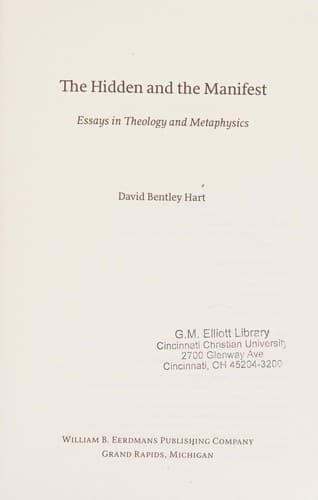
The Hidden and the Manifest: Essays in Theology and Metaphysics
الخفي والظاهر: مقالات في اللاهوت والميتافيزيقا
Le Caché et le Manifeste : Essais en Théologie et Métaphysique
Editorial summary
David Bentley Hart's The Hidden and the Manifest presents a collection of essays that advances a sophisticated defense of classical theism while mounting pointed critiques of both modern atheism and certain strands of contemporary Christian theology. Hart employs his characteristic blend of philosophical rigor, theological erudition, and literary sensibility to argue that authentic theistic metaphysics has been largely forgotten in modernity, leading to impoverished debates about God's existence.
The collection's central thesis maintains that God, properly understood in the classical tradition, is not a being among beings but Being itself—the transcendent ground of all existence. Hart contends that most contemporary arguments about God, whether from atheists or theists, fail to grasp this fundamental distinction. He particularly targets the "theistic personalism" prevalent in much Anglo-American philosophy of religion, which he argues reduces God to a supreme entity within the universe rather than recognizing divine transcendence.
Hart's methodology combines historical retrieval with constructive metaphysical argument. He draws extensively from Patristic sources, medieval scholastics, and Eastern Orthodox theology to reconstruct what he considers the authentic Christian philosophical tradition. This approach allows him to argue that figures like Richard Dawkins and Daniel Dennett attack a caricature rather than the God of classical theism. Their critiques, Hart suggests, often apply more accurately to the anthropomorphic deity of modern fundamentalism than to the God articulated by Gregory of Nyssa or Thomas Aquinas.
The essays also engage broader questions of consciousness, beauty, and moral experience as phenomena that point beyond naturalistic explanation. Hart argues that the very intelligibility of the universe, the emergence of subjective experience, and the reality of transcendental values all require grounding in an absolute reality that transcends the physical order. His treatment of these topics responds to contemporary naturalist philosophers while drawing on phenomenological insights from thinkers like Jean-Luc Marion.
The work's significance lies in its sophisticated restatement of classical theism for contemporary discourse. By exposing what he views as the metaphysical confusion underlying much modern God-talk, Hart attempts to elevate the intellectual level of debates about theism. His essays challenge both secular critics and religious believers to engage with more philosophically robust conceptions of divinity, making the collection essential reading for understanding current high-level theological and philosophical exchanges about God's existence and nature.
Argument formulations engaged
Hart, David Bentley (2017). The Hidden and the Manifest: Essays in Theology and Metaphysics. Eerdmans.
@book{the-hidden-and-the-manifest-essays-in-th,
  author    = {Hart, David Bentley},
  title     = {The Hidden and the Manifest: Essays in Theology and Metaphysics},
  year      = {2017},
  publisher = {Eerdmans},
  url       = {https://god-database.com/en/works/the-hidden-and-the-manifest-essays-in-theology-and-metaphysics-2017}
}