
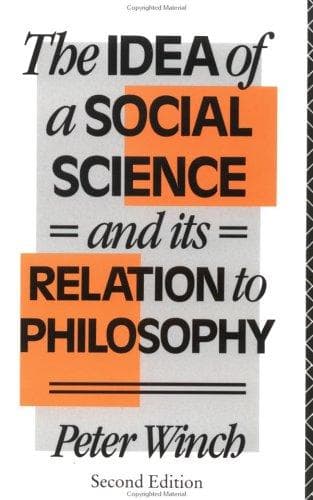
The Idea of a Social Science and its Relation to Philosophy
فكرة العلم الاجتماعي وعلاقتها بالفلسفة
L'Idée d'une science sociale et sa relation à la philosophie
Editorial summary
Peter Winch's seminal monograph challenges the prevailing scientistic approach to understanding human behavior by arguing that social inquiry fundamentally differs from natural science. Drawing heavily on Wittgenstein's later philosophy, Winch contends that meaningful human action cannot be explained through causal laws but must be understood through the rules and concepts internal to particular forms of life. This philosophical intervention carries significant implications for how scholars approach religious belief and practice, including questions about God.
Winch rejects the positivist assumption that social sciences should emulate natural sciences by seeking universal laws governing human behavior. Instead, he argues that understanding social phenomena requires grasping the concepts and rules that make actions intelligible within specific cultural contexts. Human behavior is not merely physical movement but rule-governed activity whose meaning derives from shared linguistic practices. This approach directly challenges reductionist accounts that would explain religious belief as merely psychological projection, social control, or evolutionary adaptation.
The work's significance for the God debate lies in its defense of the autonomy and intelligibility of religious discourse. Winch argues that religious language and practice constitute a distinct form of life with its own internal logic that cannot be reduced to scientific or empirical categories. Attempts to evaluate religious claims by external scientific standards fundamentally misunderstand the nature of religious belief. This position undermines both crude atheistic dismissals of religion as primitive error and natural theology's efforts to prove God's existence through empirical evidence or logical demonstration.
Winch's methodology involves careful philosophical analysis of how concepts function within different language games, showing that criteria for truth and rationality vary across different domains of human life. His critique extends to anthropological and sociological studies that impose external explanatory frameworks on religious practices without first understanding their meaning for participants. This approach influenced subsequent philosophers of religion who argue that religious belief operates according to distinct grammatical rules not reducible to scientific or metaphysical propositions.
The monograph's lasting contribution lies in establishing that questions about God cannot be resolved through scientific methodology or abstract philosophical argument alone. Instead, understanding religious belief requires attention to the lived practices and conceptual frameworks within which God-talk becomes meaningful. Winch thus opens space for taking religious discourse seriously on its own terms while avoiding both uncritical acceptance and reductive dismissal.
Winch, Peter (1958). The Idea of a Social Science and its Relation to Philosophy. Humanities Press, Routledge & Kegan Paul.
@book{the-idea-of-a-social-science-and-its-rel,
  author    = {Winch, Peter},
  title     = {The Idea of a Social Science and its Relation to Philosophy},
  year      = {1958},
  publisher = {Humanities Press, Routledge & Kegan Paul},
  url       = {https://god-database.com/en/works/the-idea-of-a-social-science-and-its-relation-to-philosophy-1958}
}