
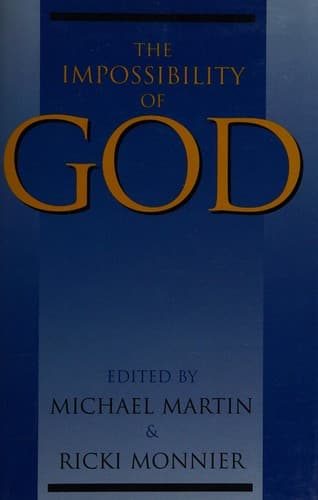
The Impossibility of God
استحالة وجود الإله
L'impossibilité de Dieu
The concept of God as traditionally defined in classical theism is logically self-contradictory, making the existence of such a being not merely unproven but strictly impossible.
Editorial summary
This collection presents a comprehensive philosophical assault on theistic belief, marshaling arguments from leading atheist philosophers to demonstrate what the contributors regard as the logical impossibility of God's existence. Martin and Monnier assemble essays that move beyond mere skepticism to argue that the concept of God contains internal contradictions that render divine existence not merely improbable but conceptually incoherent.
The volume's distinctive contribution lies in its systematic examination of divine attributes and their alleged incompatibilities. Rather than focusing solely on empirical arguments against God's existence, contributors analyze the logical tensions within classical theistic definitions. Essays explore contradictions between omniscience and human freedom, between divine immutability and God's purported actions in time, and between perfect goodness and the creation of a world containing evil. The analytic method dominates throughout, with contributors employing formal logic, conceptual analysis, and careful argumentation to expose what they view as fatal flaws in theistic metaphysics.
The problem of evil receives extensive treatment, but with a particular twist. Rather than merely arguing that evil makes God's existence unlikely, several contributors argue that the existence of evil combined with traditional divine attributes generates logical contradictions. If God is omnipotent, omniscient, and perfectly good, they contend, then the existence of any evil becomes not just puzzling but impossible. The volume thus advances strong logical arguments from evil rather than evidential ones.
Martin's editorial framework situates these arguments within contemporary philosophy of religion, engaging directly with sophisticated theistic philosophers like Alvin Plantinga, Richard Swinburne, and William Lane Craig. The collection responds to modal arguments, free will defenses, and attempts to reconcile divine attributes through careful philosophical analysis. Each essay builds on established atheological literature while advancing novel critiques.
The work's significance extends beyond academic philosophy of religion. By arguing for the impossibility rather than the mere improbability of God, the volume challenges moderate positions that view theism as a rational option among others. It forces engagement with fundamental questions about conceptual coherence, the limits of religious language, and whether traditional theism can withstand logical scrutiny. For defenders of theism, the collection presents formidable challenges requiring sophisticated responses. For atheist philosophy, it represents an ambitious attempt to demonstrate that theistic belief fails not just evidentially but at the level of basic conceptual coherence.
Argument formulations engaged
Martin, Michael The Impossibility of God. Prometheus Books.
@book{the-impossibility-of-god,
  author    = {Martin, Michael},
  title     = {The Impossibility of God},
  year      = {n.d.},
  publisher = {Prometheus Books},
  url       = {https://god-database.com/en/works/the-impossibility-of-god}
}