
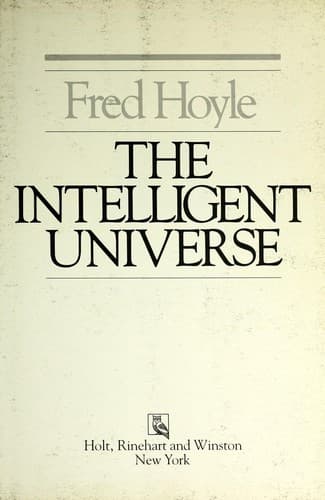
The Intelligent Universe
الكون الذكي
L'Univers Intelligent
Editorial summary
This monograph presents astrophysicist Fred Hoyle's controversial argument that the universe exhibits signs of intelligent design through its fundamental physical constants and biological complexity. Writing against the prevailing scientific orthodoxy of neo-Darwinian evolution and cosmic accident, Hoyle marshals evidence from cosmology, chemistry, and biology to suggest that intelligence pervades the cosmos at every scale.
Hoyle begins with the anthropic principle, examining how the universe's physical constants appear precisely calibrated for the emergence of carbon-based life. He calculates the probability of carbon's unique nuclear resonance occurring by chance, finding it astronomically improbable. This leads him to propose that the universe's parameters suggest purposeful tuning rather than random occurrence. His analysis extends to stellar nucleosynthesis, where he argues that the specific conditions required for element formation in stars indicate forethought rather than fortunate accident.
The work's most provocative claims concern biological evolution. Hoyle challenges conventional evolutionary theory by calculating the mathematical probability of proteins forming spontaneously from amino acids. His calculations suggest that the random assembly of even simple enzymes exceeds the probabilistic resources of the known universe. He proposes instead that genetic information arrives on Earth from space through panspermia, directed by a cosmic intelligence that transcends traditional theological categories.
Hoyle's methodology combines rigorous mathematical analysis with speculative cosmology. He employs probability theory, quantum mechanics, and astronomical observation to build his case, while acknowledging that his conclusions venture beyond empirical verification. His critique targets both religious fundamentalism and scientific materialism, positioning his theory as a third way that accepts neither biblical creation nor purposeless evolution.
The significance of Hoyle's argument lies in its challenge to scientific naturalism from within science itself. By using the tools of physics and mathematics to question materialist assumptions, he reopens debates about teleology that many considered settled. His work influences subsequent discussions of fine-tuning and intelligent design, though his specific theory of cosmic intelligence finds few adherents. The text demonstrates how scientific expertise can lead to radically different interpretations of the same evidence, depending on one's philosophical starting points. While Hoyle rejects traditional theism, his vision of an intelligent universe provides ammunition for those arguing against purely naturalistic explanations of cosmic and biological order.
Argument formulations engaged
Hoyle, Fred (1983). The Intelligent Universe. Michael Joseph.
@book{the-intelligent-universe-1983,
  author    = {Hoyle, Fred},
  title     = {The Intelligent Universe},
  year      = {1983},
  publisher = {Michael Joseph},
  url       = {https://god-database.com/en/works/the-intelligent-universe-1983}
}