
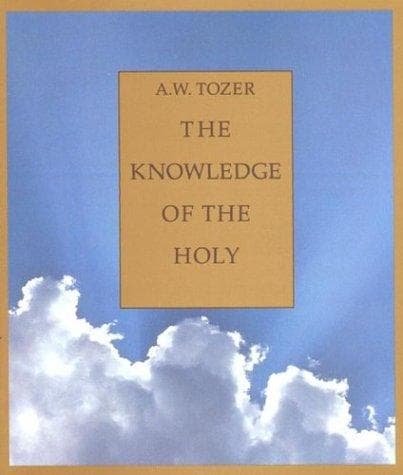
The Knowledge of the Holy
معرفة القدوس
La Connaissance du Saint
Editorial summary
A. W. Tozer's The Knowledge of the Holy presents a sustained meditation on the attributes of God, arguing that the recovery of a proper conception of divine nature stands as the most urgent theological task facing mid-20th century Christianity. Writing against what he perceives as the church's diminished vision of God, Tozer contends that contemporary religious thought has accommodated itself to secular assumptions, producing a conception of deity that bears little resemblance to the transcendent God of classical Christian theology.
The work proceeds through systematic examination of divine attributes, including God's self-existence, self-sufficiency, eternity, infinitude, immutability, omniscience, wisdom, omnipotence, transcendence, omnipresence, faithfulness, goodness, justice, mercy, grace, love, holiness, and sovereignty. Tozer's method combines devotional reflection with theological exposition, drawing extensively from Scripture, Christian mystics, Puritan divines, and classical theological sources. His approach deliberately eschews technical philosophical argumentation in favor of accessible prose designed to inspire worship rather than merely inform the intellect.
Central to Tozer's argument is the claim that proper knowledge of God must be experiential rather than merely propositional. He critiques both liberal theology's reduction of God to human categories and fundamentalism's tendency toward rigid doctrinal formulations divorced from spiritual experience. Against both tendencies, Tozer advocates for a recovery of the mystical tradition within Protestant Christianity, arguing that authentic knowledge of God emerges through prayerful contemplation of divine attributes rather than through rational demonstration or empirical investigation.
The work's significance lies in its challenge to prevailing mid-20th century theological trends. Writing during a period marked by theological liberalism's influence and existentialism's rise, Tozer reasserts classical theism's emphasis on divine transcendence and otherness. His critique extends to popular Christianity's anthropomorphic tendencies, which he argues have produced a "God of our own making" rather than submission to the God revealed in Scripture and encountered in mystical experience.
While not engaging directly with philosophical arguments for God's existence, The Knowledge of the Holy contributes to the God debate by articulating a vision of deity that emphasizes divine mystery and transcendence against reductionist accounts. Tozer's work influenced subsequent evangelical theology and spiritual writing, helping preserve classical theistic categories within Protestant thought while advocating for their experiential appropriation through contemplative practice.
Argument formulations engaged
Tozer, A. W. (1961). The Knowledge of the Holy. Reformed Church Publications.
@book{the-knowledge-of-the-holy-1961,
  author    = {Tozer, A. W.},
  title     = {The Knowledge of the Holy},
  year      = {1961},
  publisher = {Reformed Church Publications},
  url       = {https://god-database.com/en/works/the-knowledge-of-the-holy-1961}
}