
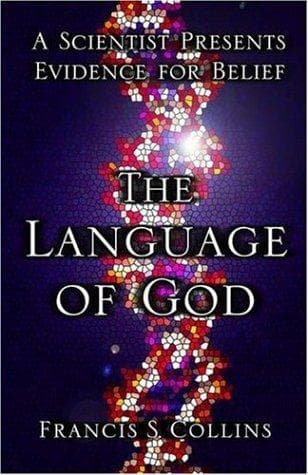
The Language of God.. A Scientist Presents Evidence for Belief
لغة الله.. عالم يقدم أدلة على الإيمان
Le Langage de Dieu.. Un scientifique présente des preuves en faveur de la croyance
A practicing scientist can accept evolution and modern cosmology while still finding belief in God rational and existentially compelling.
Editorial summary
Francis Collins presents a distinctive synthesis of scientific expertise and Christian faith in The Language of God, arguing that modern genetics and cosmology provide compelling evidence for belief in God. As the former director of the Human Genome Project, Collins brings unique authority to debates about science and religion, positioning himself against both scientific materialism and religious fundamentalism. His central thesis maintains that scientific discovery, properly understood, points toward rather than away from divine creation.
Collins develops his argument through three interconnected claims. First, he advances a version of the fine-tuning argument, emphasizing how the precise calibration of physical constants necessary for life suggests intentional design. Drawing on contemporary cosmology, he argues that the extraordinary improbability of a life-permitting universe demands explanation beyond chance or necessity. Second, Collins presents a moral argument rooted in human experience of the Moral Law—an innate sense of right and wrong that transcends evolutionary explanations. He contends that altruistic behavior, particularly when it contradicts survival interests, points to a divine source of moral awareness. Third, he employs a reason and rationality argument, suggesting that the human capacity for abstract thought, mathematics, and scientific investigation itself requires grounding in a rational Creator.
The work engages primarily with the New Atheist movement, particularly Richard Dawkins and Daniel Dennett, while also critiquing young-earth creationism and intelligent design theory. Collins advocates for "BioLogos" or evolutionary creation, arguing that evolution represents God's method of creation. This mediating position seeks to preserve both scientific integrity and theological orthodoxy. His approach synthesizes Augustinian theology with contemporary science, drawing on C.S. Lewis's moral philosophy and Alvin Plantinga's epistemology.
The significance of Collins' contribution lies in its source: a leading scientist making a case for theism from within the scientific establishment. His argument that science and faith occupy complementary rather than conflicting domains challenges predominant narratives of inevitable conflict. By demonstrating how a practicing scientist can maintain both rigorous empiricism and sincere faith, Collins provides a model for integrating seemingly disparate worldviews. His work represents an important voice in contemporary science-religion dialogue, offering sophisticated responses to materialist critiques while maintaining commitment to mainstream scientific consensus.
Structured analysis
Argument formulations engaged
Related works
Collins, Francis (2006). The Language of God.. A Scientist Presents Evidence for Belief. Free Press.
@book{the-language-of-god-a-scientist-presents,
  author    = {Collins, Francis},
  title     = {The Language of God.. A Scientist Presents Evidence for Belief},
  year      = {2006},
  publisher = {Free Press},
  url       = {https://god-database.com/en/works/the-language-of-god-a-scientist-presents-evidence-for-belief}
}