
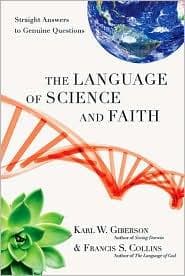
The Language of Science and Faith: Straight Answers to Genuine Questions
لغة العلم والإيمان: إجابات مباشرة على أسئلة حقيقية
Le Langage de la Science et de la Foi : Réponses Directes à des Questions Authentiques
Editorial summary
This work represents a significant contribution to the science-religion dialogue from one of America's most prominent scientists. Francis Collins, geneticist and former director of the National Institutes of Health, articulates a robust defense of theistic evolution, arguing that modern scientific discoveries, particularly in genetics and cosmology, are not merely compatible with Christian faith but actually enhance theological understanding. The book directly challenges both scientific materialism and biblical literalism, positioning itself as a mediating voice in contemporary cultural conflicts over origins.
Collins employs a question-and-answer format to address common concerns about reconciling evolutionary science with belief in God. Drawing extensively on his leadership of the Human Genome Project, he presents genetic evidence for common descent while maintaining that natural processes reflect divine creativity rather than random meaninglessness. The work engages critically with the Intelligent Design movement, arguing that ID proponents make a category mistake by inserting supernatural explanations into scientific methodology. Simultaneously, Collins critiques young-earth creationism as both scientifically untenable and theologically unnecessary, advocating instead for a non-literal interpretation of Genesis that preserves spiritual truth while accepting scientific evidence.
The book's philosophical framework rests on the distinction between mechanism and meaning. Collins contends that science excellently describes how the universe operates but cannot address why it exists or what purposes it serves. He develops this through discussions of fine-tuning in cosmological constants, the emergence of moral consciousness, and the human capacity for transcendent experience. These phenomena, he argues, point beyond naturalistic explanation without violating scientific principles.
Methodologically, Collins combines personal narrative with scientific exposition and theological reflection. His conversion from atheism to Christianity provides experiential grounding for his arguments, while his scientific credentials lend authority to his rejection of conflict models. The work particularly targets educated lay readers struggling to integrate religious faith with scientific literacy, offering what Collins terms "BioLogos" as a synthesis honoring both domains.
The book's significance lies in its demonstration that prominent scientists can maintain orthodox Christian belief without compartmentalization or intellectual compromise. By presenting theistic evolution as intellectually rigorous and spiritually satisfying, Collins challenges the widespread assumption that scientific advancement necessarily leads to secularization, offering instead a vision of science as exploration of divine creativity.
Argument formulations engaged
Collins, Francis (2011). The Language of Science and Faith: Straight Answers to Genuine Questions. IVP Books.
@book{the-language-of-science-and-faith-straig,
  author    = {Collins, Francis},
  title     = {The Language of Science and Faith: Straight Answers to Genuine Questions},
  year      = {2011},
  publisher = {IVP Books},
  url       = {https://god-database.com/en/works/the-language-of-science-and-faith-straight-answers-to-genuine-questions-2011}
}