
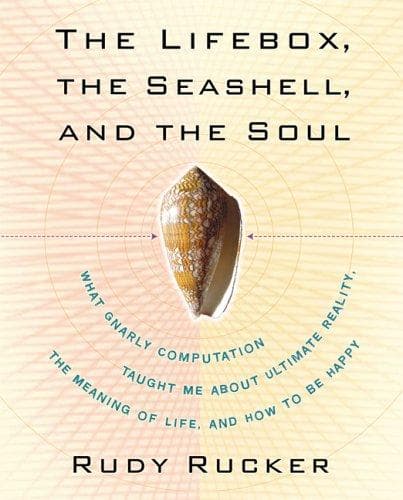
The Lifebox, the Seashell, and the Soul: What Gnarly Computation Taught Me About Ultimate Reality, The Meaning of Life, And How to Be Happy
صندوق الحياة والصدفة والروح: ما علمتني إياه الحوسبة المعقدة عن الواقع المطلق ومعنى الحياة وكيفية السعادة
La Boîte de vie, le coquillage et l'âme : Ce que le calcul complexe m'a appris sur la réalité ultime, le sens de la vie, et comment être heureux
Editorial summary
This work explores the intersection of computational theory, consciousness, and metaphysical questions through the lens of complex systems and cellular automata. Rucker, a mathematician and computer scientist, develops a computational philosophy of mind that challenges traditional dualistic approaches to consciousness while engaging with fundamental questions about reality's nature and humanity's place within it.
The book's central argument posits that consciousness emerges from what Rucker terms "gnarly computation" — processes exhibiting complexity between predictable order and complete randomness. Drawing on Stephen Wolfram's cellular automata research and contemporary theories of emergence, Rucker proposes that minds function as universal computers capable of emulating any possible computation. This computational universality, he argues, provides a naturalistic foundation for understanding both consciousness and free will without invoking supernatural explanations.
Rucker's approach directly challenges both materialist reductionism and traditional theistic accounts of consciousness. Against reductionists, he maintains that computational complexity creates genuine emergent properties irreducible to simple physical processes. Against theists, he argues that consciousness requires no divine spark or immaterial soul, emerging instead from sufficiently complex computational processes. His "Principle of Computational Equivalence" suggests that all universal computers — including human minds — possess equal computational power, democratizing consciousness across various physical substrates.
The work's philosophical significance lies in its attempt to naturalize traditionally spiritual concepts through computational metaphors. Rucker reinterprets immortality as informational persistence, viewing personalities as patterns potentially transferable across substrates (the "lifebox" concept). He addresses life's meaning through computational creativity and pattern generation, proposing that happiness derives from engaging with optimal complexity levels — neither too ordered nor too chaotic.
While not explicitly atheistic, Rucker's framework eliminates traditional theological explanations for consciousness, meaning, and value. His computational panpsychism suggests that mentality pervades nature through universal computation, offering a middle path between eliminative materialism and substance dualism. The work contributes to contemporary debates about artificial intelligence, mind uploading, and the relationship between information theory and consciousness.
Rucker's synthesis draws from diverse sources including Buddhist philosophy, beat literature, and mathematical logic, presenting a worldview where traditional spiritual concerns find expression through computational processes. His work represents a significant attempt to bridge the explanatory gap between objective physical processes and subjective experience through the unifying framework of computation.
Argument formulations engaged
Rucker, Rudy (2005). The Lifebox, the Seashell, and the Soul: What Gnarly Computation Taught Me About Ultimate Reality, The Meaning of Life, And How to Be Happy. Basic Books.
@book{the-lifebox-the-seashell-and-the-soul-wh,
  author    = {Rucker, Rudy},
  title     = {The Lifebox, the Seashell, and the Soul: What Gnarly Computation Taught Me About Ultimate Reality, The Meaning of Life, And How to Be Happy},
  year      = {2005},
  publisher = {Basic Books},
  url       = {https://god-database.com/en/works/the-lifebox-the-seashell-and-the-soul-what-gnarly-computation-taught-me-about-ultimate-reality-the-meaning-of-life-and-how-to-be-happy-2005}
}